
+86-182-1720-1300 zhaoxuemei1@huxishiye.com
Language
Please Choose Your Language

Views: 0 Author: Site Editor Publish Time: 2026-08-08 Origin: Site


Scaling sample preparation throughput without expanding physical bench space presents a compounding challenge for modern laboratories. Mixing consistency remains paramount, yet traditional setups often fail to deliver uniformity when processing batches simultaneously. Relying on arrays of single-position stirrers creates operational bottlenecks, increases labor costs, and introduces unacceptable batch-to-batch variability. Managing power cords, disparate calibrations, and uneven heating profiles across multiple units quickly becomes unsustainable on a crowded benchtop. A Multi Position Magnetic Stirrer serves as a targeted solution for specific high-throughput applications. This equipment consolidates parallel processing into a single footprint, ensuring uniform agitation across multiple vessels. Evaluating whether this equipment aligns with a lab's specific volume, viscosity, and compliance requirements requires a structured approach. This guide examines the architecture, operational limitations, and procurement logic necessary to determine when a laboratory should transition to synchronized parallel mixing systems.
Throughput vs. Footprint: Multi position units consolidate parallel processing, reducing benchtop footprint by up to 70% compared to equivalent single-unit arrays.
Reproducibility: Synchronized motor designs ensure identical RPM across all samples, eliminating mechanical variability in comparative studies and parallel synthesis.
Operational Limitations: These units excel in low-to-medium viscosity applications but may experience magnetic decoupling in highly viscous solutions or at extreme volumes.
Procurement Logic: The ROI of a multi position setup is justified when a lab processes batches of 4+ identical samples daily, requiring strict environmental and agitation uniformity.
When you run parallel extractions or dissolution tests, the baseline requirements for success are non-negotiable. You need absolute RPM stability, tight temperature uniformity, and maximum operator hands-off time. High-throughput mixing demands consistent kinetic energy transfer across all samples simultaneously. If one beaker in a six-position array drops by 50 RPM, the dissolution rate for that specific sample lags, skewing the entire batch data. Operators need systems that maintain set parameters without continuous manual intervention or babysitting. Success depends on achieving identical dissolution rates and reaction kinetics across the entire batch, which is nearly impossible when manually adjusting dials on six different stir plates.
Using multiple individual magnetic stirrers introduces hidden costs and operational hazards that compound as throughput scales. Cable management becomes chaotic. Daisy-chaining power strips across a wet bench increases safety risks and violates basic lab safety protocols. Inconsistent calibration across disparate units leads to variable mixing speeds, even when the analog dials are set to the exact same position. Disparate heating profiles cause temperature gradients; one plate might run at 80°C while the adjacent unit struggles to hit 75°C. Running numerous individual motors also results in excessive power consumption and wasted bench space, leaving little room for actual sample manipulation or analytical balances.
Minor RPM deviations across separate units compromise reaction kinetics and overall data integrity. In QC/QA environments, inconsistent agitation alters dissolution rates, leading to failed assays, out-of-specification (OOS) investigations, or required retesting. Parallel workflows demand strict uniformity to ensure comparative studies remain valid. Eliminating mechanical variability prevents costly errors in standardized testing protocols. When you are running a 12-vessel parallel synthesis, a 5% variance in agitation speed can change the yield of the final compound, rendering the comparative data useless.
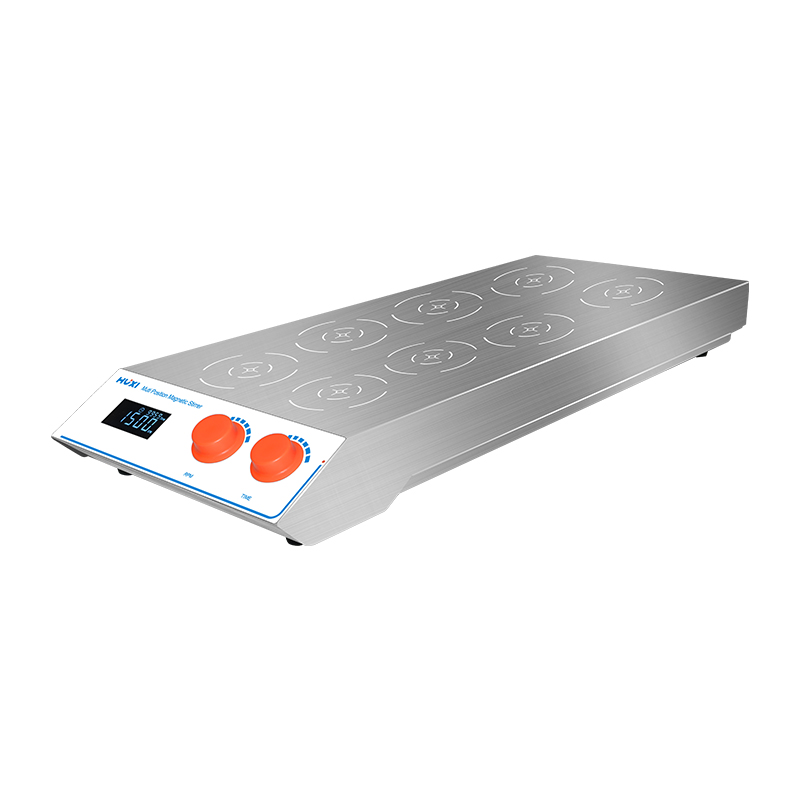
Synchronized systems utilize a single-motor belt-driven mechanism or a unified magnetic coil board to ensure identical RPM across all points. This design guarantees uniformity for comparative studies. If you set the unit to 400 RPM, all 10 positions spin at exactly 400 RPM. Conversely, multi-motor systems offer independent RPM control per position, allowing operators to run different protocols simultaneously. Selecting the right mechanism depends on whether the workflow requires identical agitation for batch consistency or variable processing conditions for method development.
A hot plate magnetic stirrer combines agitation with thermal control. Internal heating elements distribute energy across the top plate for parallel incubation. Uniform heat distribution remains critical for parallel synthesis and media preparation. Evaluating thermal uniformity ensures that edge positions receive the same thermal input as central positions. High-end models utilize thick aluminum or ceramic-coated plates to mitigate cold spots. When running a 4x4 grid, the corner vessels must reach the target temperature at the same rate as the center vessels to maintain reaction parity.
Modern wear-free inductive coil systems offer distinct advantages over traditional motorized magnets. Coil-driven units feature ultra-thin profiles, often less than two inches thick, and generate minimal heat emission. This prevents unwanted sample warming in non-heating applications, which is vital for temperature-sensitive biological samples. Motor-driven systems typically handle larger volumes and higher viscosities due to stronger magnetic coupling, but they require more maintenance due to moving belts and bearings. Longevity and application requirements dictate the appropriate drive technology. Coil systems excel in cell culture and microbiology, while motor-driven units dominate heavy chemical synthesis.
Physical spacing between positions, known as pitch, dictates compatibility with standard labware. Pitch limits maximum vessel diameters, determining whether the unit accommodates 50mL beaker arrays, 96-well microplates, or 1L specialized media bottles. Evaluating grid configurations ensures the equipment aligns with the specific glassware utilized in the laboratory's daily workflows. A 15-position stirrer with a 65mm pitch will easily hold 50mL Erlenmeyer flasks but will physically reject an array of 250mL flasks. You must map your standard vessel footprint against the manufacturer's pitch specifications before procurement.
Labs managing continuous media prep, buffer formulation, or standardized titrations require efficient parallel processing. A parallel sample stirrer streamlines these repetitive tasks. Preparing multiple reagents simultaneously reduces labor hours and ensures consistency across batches. This equipment proves essential for high-throughput analytical laboratories where technicians spend hours daily mixing mobile phases for HPLC or preparing dissolution media. Consolidating this into a single 10-position run frees up the technician for higher-level analytical tasks.
Combinatorial chemistry, drug discovery, and parallel extraction protocols demand identical agitation. Synchronized multi position units provide the exact RPM across all samples, ensuring reproducible reaction kinetics. Eliminating mechanical variability remains crucial when comparing multiple synthetic pathways or optimizing extraction parameters. If you are screening catalysts across eight different vials, the mass transfer rate must be identical. Any variation in stirring speed alters the diffusion layer, directly impacting the reaction rate and leading to false conclusions about catalyst efficacy.
Consolidating 5, 10, or 15 stirring points into a single chassis maximizes available workspace. A unified power supply reduces cable clutter and improves energy efficiency. For laboratories operating in confined spaces, the spatial ROI of a multi position unit justifies the investment by freeing up critical benchtop real estate. A standard 15-position stirrer occupies roughly the same footprint as two standard single-position stir plates. This 80% reduction in spatial requirement allows labs to scale throughput without requiring facility expansion or additional fume hoods.
Workflows requiring remote-controlled, hermetically sealed stirring assemblies benefit from specialized multi position units. These systems operate safely inside CO2 incubators, environmental chambers, or fume hoods. Low heat emission and high IP ratings ensure reliable operation in high-humidity or corrosive environments without disrupting internal chamber conditions. When culturing cells in a 37°C incubator, you cannot introduce a motor that generates excess ambient heat. Coil-driven multi-position stirrers run cold, maintaining the strict environmental parameters required for mammalian cell lines or temperature-sensitive protein crystallizations.
Mapping the volume-to-throughput ratio clarifies equipment selection. A single position magnetic stirrer handles larger vessels exceeding 5L, providing the magnetic flux density required to spin large bars through deep liquid columns. Multi position units excel with arrays of 50mL to 2L vessels, prioritizing horizontal scalability over vertical volume. Overhead stirrers remain necessary for bulk processing and pilot-scale scale-up. Scalability depends on balancing vessel size against the required number of simultaneous reactions.
Magnetic coupling faces physical limitations in parallel setups. High-viscosity liquids or extreme volumes cause magnetic decoupling, leading to spin-out where the stir bar rattles uselessly at the bottom of the flask. Overhead mechanical stirrers provide the high-torque capabilities required for viscous materials like polymers, heavy oils, or dense slurries. Multi position magnetic units remain optimized for low-to-medium viscosity aqueous solutions and standard solvent mixtures. If your dynamic viscosity exceeds 100 cP, parallel magnetic stirring will likely fail, necessitating a shift to overhead impellers.
Evaluating the long-term operational footprint requires looking at maintenance schedules, energy consumption, and calibration demands. A parallel sample stirrer consolidates the mechanical wear into a single chassis. Instead of calibrating ten individual motors annually, the metrology team calibrates one unit. Energy consumption drops significantly when utilizing a single unified power supply compared to ten separate transformers drawing phantom power. The expected lifespan of a high-quality parallel unit often exceeds individual plates because they are engineered for continuous, heavy-duty industrial use rather than intermittent academic applications.
Equipment Type | Optimal Volume Range | Viscosity Capability | Throughput Capacity | Primary Application |
|---|---|---|---|---|
Single Position Magnetic Stirrer | Up to 20L+ | Low to Medium | Single Sample | Bulk media prep, large batch mixing |
Multi Position Magnetic Stirrer | 50mL - 2L per position | Low | High (4-15+ Samples) | Parallel synthesis, serial dilutions |
Overhead Stirrer | Up to 100L+ | High | Single Sample | Polymer synthesis, high-viscosity slurries |
Brushless DC (BLDC) motors provide continuous operation and reliable RPM stability without the carbon dust generation associated with brushed motors. Stepper motors offer precise low-speed control necessary for delicate biological samples. Evaluating motor types ensures the equipment matches the required agitation profile, preventing cellular shear or inadequate mixing during extended protocols. For aggressive chemical mixing, high-torque BLDC motors prevent stalling when adding solid reagents to a liquid phase.
Top plate materials dictate chemical resistance and thermal conductivity. Ceramic surfaces offer excellent chemical resistance against strong acids and bases, making them ideal for titration stations. However, ceramic has lower thermal conductivity. Stainless steel provides durability and easy decontamination for cleanroom environments. Aluminum ensures rapid, uniform thermal distribution, making it the preferred choice for hot plate models where temperature parity across the grid is critical. Selecting the appropriate material mitigates spill risks and optimizes heating requirements.
High IP ratings protect internal components from corrosive chemical spills and high humidity. IP42 ratings offer basic protection against vertical drips, suitable for general dry lab work. IP65 ratings allow for rigorous cleaning, washdowns, and operation in harsh environments like wet chemistry labs or cold rooms. Evaluating enclosure ratings prevents premature equipment failure. If your workflow involves frequent splashing of saline solutions, an unsealed unit will suffer rapid internal corrosion, leading to electrical shorts and motor failure.
Regulated environments require precise documentation. RS232, USB, or Bluetooth interfaces enable data logging and remote control via laboratory information management systems (LIMS). Programmable ramp and soak profiles automate complex workflows, allowing operators to set multi-step agitation protocols that run overnight. GLP/GMP compliance logging ensures traceability for quality control and audit requirements. Digital feedback loops maintain exact RPM even as sample viscosity changes slightly during a reaction.
Executing IQ/OQ/PQ protocols requires verifying RPM and temperature across all positions. Calibrating multiple individual positions simultaneously ensures regulatory compliance. Reviewing verification procedures prior to procurement guarantees the equipment meets strict quality assurance standards. You must confirm that the manufacturer provides multi-point mapping certificates, proving that position 1 and position 15 operate within the stated tolerance limits.
Stir bars decoupling in high-viscosity samples or off-center vessels disrupts workflows and destroys samples. Proper stir bar geometry selection, such as cylindrical, pivot ring, or cross-shaped designs, improves coupling. Utilizing rare-earth SmCo or NdFeB magnets increases magnetic strength significantly over standard Alnico magnets. Implementing gradual RPM ramping features prevents sudden decoupling during initial agitation. Always match the stir bar length to the vessel diameter and the magnetic pole spacing of the drive unit.
Edge-cooling effects on a multi position hot plate magnetic stirrer cause temperature variations across the grid. The outer edges lose heat to the ambient air faster than the center. Utilizing external PT1000 temperature sensors monitors actual sample temperatures rather than relying on plate surface readings. Insulated thermal blocks stabilize sample temperatures, mitigating cross-heating and ensuring uniformity across all positions. Aluminum reaction blocks that fit precisely over the stirring positions provide thermal mass, shielding the vials from ambient drafts.
If a synchronized unit fails, the entire parallel workflow stops. This single-point failure risk requires proactive management. Establishing preventative maintenance schedules minimizes downtime risk. Verifying warranty and service SLA terms prior to purchase ensures rapid repair or replacement. Maintaining backup single-position units provides redundancy for critical continuous processes. Keep spare drive belts and replacement top plates in inventory to facilitate rapid on-site repairs without waiting for manufacturer service technicians.
Multi position magnetic stirrers serve as specialized tools for labs constrained by space and burdened by parallel processing variability. They consolidate workflows, ensure reproducible kinetic energy transfer, and streamline high-throughput applications. Transitioning to synchronized parallel mixing requires careful evaluation of volume capacities, viscosity limitations, and spatial requirements. By matching the drive technology and grid configuration to your specific labware and chemical applications, you eliminate the bottlenecks associated with single-unit arrays.
Audit your current daily sample batch sizes to determine the exact throughput capacity required for your workflows.
Measure your available bench space to calculate the potential spatial return on investment of consolidating equipment.
Evaluate the dynamic viscosity of your standard samples to ensure magnetic coupling reliability before purchasing.
Request technical specification sheets from manufacturers to verify pitch spacing and vessel compatibility with your existing glassware.
A: Maximum volume typically ranges from 400mL to 2L per position, depending on the specific model and grid configuration. Pitch spacing and magnetic drive strength dictate the practical volume limits. Always verify the manufacturer's specifications against your standard flask sizes to ensure reliable agitation without magnetic decoupling.
A: Most synchronized units use a single motor or unified coil board to deliver identical RPM across all points. However, specific asynchronous multi-motor models offer independent RPM control for each position, allowing operators to run diverse protocols and varying speeds simultaneously on the same chassis.
A: Internal heating elements distribute energy across a highly conductive top plate, usually made of aluminum. To minimize thermal gradients and edge-cooling effects, high-quality units utilize advanced PID controllers. Using external thermal blocks tailored to your vials further stabilizes sample temperatures across the entire grid.
A: No. These units are optimized for low-to-medium viscosity aqueous solutions and standard solvents. High-viscosity liquids frequently cause magnetic decoupling (spin-out) in parallel setups due to the limited torque of magnetic coupling. For highly viscous materials, overhead mechanical stirrers are required.
A: Use rare-earth magnetic stir bars (SmCo or NdFeB) for stronger coupling. Ensure all vessels are perfectly centered over the magnetic drive points. Additionally, utilize the equipment's gradual RPM ramping feature to slowly build agitation speed, preventing sudden torque that causes spin-out.
A: Yes, provided you select a model specifically designed for these environments. Coil-driven units are ideal because they generate minimal heat and often feature high IP ratings, ensuring reliable operation in high-humidity or corrosive environments without disrupting the internal chamber conditions.


