
+86-182-1720-1300 zhaoxuemei1@huxishiye.com
Language
Please Choose Your Language

Views: 0 Author: Site Editor Publish Time: 2026-08-12 Origin: Site


High-throughput sample preparation hits a hard bottleneck during homogenization. When you process dozens of extractions manually, you lose time and risk repetitive strain injury in your wrists and hands. Scaling protocols like QuEChERS, DNA extraction, or dense cell resuspension requires consistent, simultaneous mixing across all samples. Manual processing introduces variables you cannot afford. Uneven homogenization degrades sample integrity, skews analytical results, and overloads your personnel. The definitive solution for high-throughput homogenization is the Multi Tube Vortex Mixer. This equipment replaces manual handling with simultaneous, uniform agitation. We need to evaluate its exact capacity limits, tube size constraints, vessel versatility, and performance trade-offs. Understanding these parameters helps you optimize laboratory workflows without overloading the hardware or compromising data quality.
Capacity Variance by Volume: A multi tube vortex mixer can typically process anywhere from 18 large conical tubes (50 mL) up to 72 microcentrifuge tubes (1.5/2 mL) simultaneously.
Consistency Over Speed: Batch processing ensures identical vortexing duration and intensity across all samples, reducing experimental variability compared to manual mixing.
Attachment Dependency: Total throughput and vessel compatibility (including tubes, flasks, and microplates) are strictly dictated by the availability and design of interchangeable foam or solid racks.
Motor Limitations: Maximum RPM decreases as the total payload weight (tube mass + sample volume + rack weight) increases; evaluating motor torque is as critical as evaluating slot count.
Define the exact threshold where manual mixing becomes a liability. In low-throughput setups, processing one or two samples sequentially works fine. But once your protocol demands simultaneous extraction of twenty or more samples, manual mixing destroys lab efficiency, operator safety, and data reproducibility. Pressing individual tubes against a vibrating rubber cup for minutes causes rapid muscle fatigue. You end up applying inconsistent pressure, which means inconsistent mixing.
Technicians often try the handful hack to save time. They hold three to four tubes at once against a single-cup laboratory vortex mixer. The physics of vibration transfer make this a terrible idea. Your fingers act as dampeners. They absorb the kinetic energy before it reaches the liquid. The tube hitting the center of the cup gets aggressive agitation. The peripheral tubes get almost nothing.
Here is what happens when you rely on manual mixing for large batches:
Protocol deviations multiply as operator fatigue sets in during long shifts.
Pellet resuspension fails entirely in the peripheral tubes held furthest from the vibration center.
Chemical partitioning becomes uneven across the batch, skewing downstream chromatography results.
Time-delay variables ruin time-sensitive assays because the first tube sits degrading while the last tube is still being mixed.
Transitioning to a batch vortex mixer changes your workflow entirely. You load fifty samples into a specialized rack, set the timer for two minutes, and walk away. Every tube gets the exact same orbital motion, RPM, and duration. You eliminate the time-delay variable completely.
We also need to look at the mini vortex mixer. These small units fit perfectly inside tight biosafety cabinets. They handle quick, single-tube spins before you load a microcentrifuge. But they lack the footprint, base stability, and motor torque for batch payloads. If you try to modify a mini unit for batch processing, you will stall the motor or watch the unit vibrate right off your workbench.
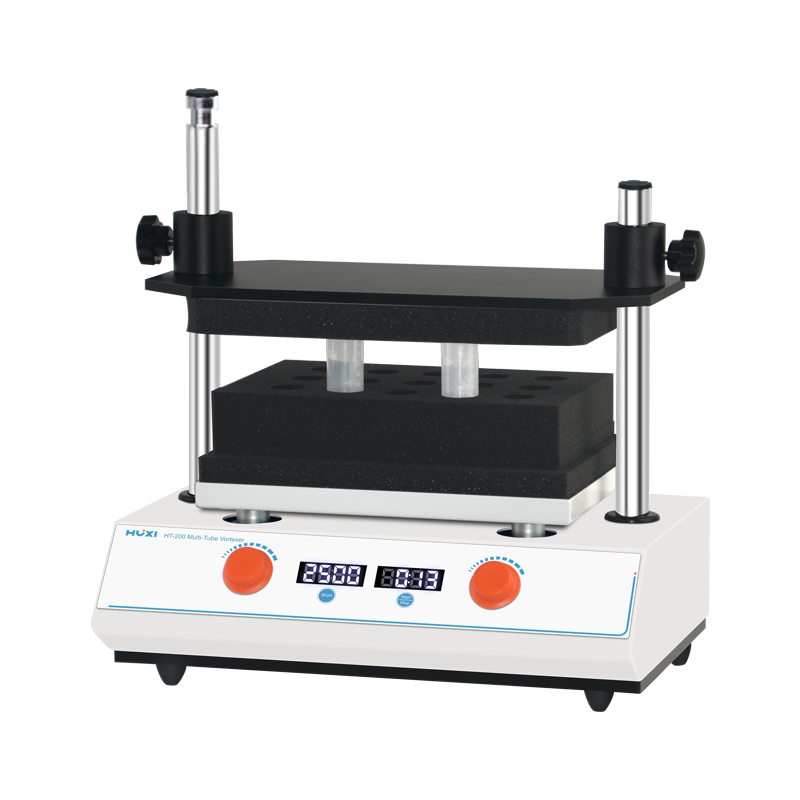
Processing capacity is not a static number. A strict inverse relationship exists between the physical volume of your sample tube and the total number of tubes the machine can process at once. Standard industry rack dimensions, platform footprint, and the physical clearance needed between tubes dictate this limit. You need clearance to prevent tubes from shattering against each other during violent oscillation.
Typical Processing Capacity by Vessel Type
Vessel Type | Typical Volume | Maximum Capacity | Primary Laboratory Application |
|---|---|---|---|
Microcentrifuge Tube | 1.5 mL to 2.0 mL | 50 to 72 | PCR preparation, DNA/RNA extraction |
Blood / Culture Tube | 5.0 mL to 7.0 mL | 60 | Clinical diagnostics, hematology |
Standard Conical Tube | 15 mL | 45 | Intermediate wash steps, cell pelleting |
Large Conical Tube | 50 mL | 15 to 18 | QuEChERS, soil extraction, bulk media |
Capacity hits its absolute maximum with micro-volumes. A standard high-throughput unit holds 50 to 72 microcentrifuge tubes in a single rack. Genomics and proteomics labs use these setups constantly for PCR preparation, enzyme reactions, and small-scale nucleic acid extractions. The total mass of 72 fully loaded 2.0 mL tubes remains low. The eccentric drive mechanism experiences minimal strain. This low payload lets the mixer maintain its maximum rated speed, often hitting 2500 RPM. You get a tight, aggressive vortex that shears tough biological samples and dissolves dense chemical pellets fast.
Mid-volume vessels reduce your total capacity because the tubes are wider. A standard rack accommodates up to 60 blood or culture tubes (5 to 7 mL) or about 45 standard 15 mL conical tubes. Clinical diagnostics, hematology labs, and cell culture wash steps rely on these configurations. 15 mL tubes introduce a higher center of gravity. Racks designed for these tubes need much deeper wells to compensate. Deep seating prevents the lateral forces of high-speed oscillation from ejecting the tubes. If a tube flies out, you lose the sample and risk biohazard exposure.
Processing 50 mL conical tubes is the heaviest standard workload. Capacity drops to 15 or 18 tubes per run. Agricultural and environmental testing labs use this setup for QuEChERS pesticide residue analysis, large-scale cell culture resuspension, and heavy soil extractions. Mixing eighteen 50 mL tubes filled with dense soil, salts, and organic solvents pushes the equipment hard. The high center of gravity and massive liquid mass force you to use lower RPM settings. You absolutely need high-torque motors here. They maintain a stable, continuous vortex without stalling the drive shaft.
A multiple tube mixer handles more than just cylindrical tubes. Swap the upper attachments, and the platform takes flat-bottom vessels. Capacity depends on the platform footprint. You can usually fit one to two deep-well microplates or four 250 mL Erlenmeyer flasks. Flat-bottom attachments push the equipment into high-throughput screening, microbiological media preparation, and bulk reagent mixing. The orbital motion creates a sweeping wave inside flasks. This wave aerates cultures and dissolves bulk powders into solution efficiently.
Your high-capacity mixing system relies entirely on its attachments. The base motor unit does nothing without the right rack for your specific vessel. Premium models offer six or more interchangeable tube racks and post-extension kits. These let the base unit handle highly specific, multi-vessel workflows.
Foam vs. Solid Rack Comparison
Feature | High-Density EVA Foam Racks | Solid Plastic / Metal Racks |
|---|---|---|
Vibration Absorption | Excellent; dampens acoustic noise significantly. | Poor; transfers full vibration to the tube. |
Fit Flexibility | High; compresses to grip varying tube diameters. | Low; requires exact dimensional matching. |
Chemical Resistance | Low; degrades when exposed to harsh organic solvents. | High; withstands spills and aggressive decontamination. |
Autoclavability | No; melts under high heat and pressure. | Yes; ideal for cleanrooms and BSL-3 environments. |
Batch processing physics force you to make trade-offs. The maximum capacity on a spec sheet rarely equals maximum performance on the bench. You have to balance speed, orbital diameter, and payload weight to get optimal homogenization.
Orbit size dictates your mixing style. The eccentric drive creates a circular motion, and the diameter of that circle is the orbit. Standard orbits range from 3.6 mm to 4.5 mm. Larger orbits generate a wide sloshing motion. You need this for large volumes in 50 mL tubes or flasks because it forces liquid up the vessel walls. Smaller orbits create tight, high-frequency vibration. This works best for micro-volumes. It disrupts stubborn pellets at the bottom of a 1.5 mL tube without splashing liquid into the cap.
RPM and payload have a strict physical trade-off. A motor rated for 2500 RPM empty will not hold that speed under a heavy payload. Load eighteen 50 mL tubes full of dense extraction buffers and soil, and the torque requirement skyrockets. The maximum safe operating speed drops to 1500 RPM. If you push the machine to its absolute maximum speed under a heavy load, you degrade the hardware rapidly.
High-capacity mixers bring specific operational risks. If you lack experience with heavy-duty orbital mechanics, user errors will cause equipment failure and sample loss.
The dead zone effect is your biggest risk. Poorly designed racks or overloaded machines cause uneven mixing. Tubes on the outer edge experience different vortexing forces than those in the center. Center tubes sit directly over the drive shaft and get the most kinetic energy. You mitigate this by running validation checks during setup. Run a dummy batch with visible dye or a standard suspension. Confirm that all rack positions achieve uniform homogenization.
Motor burnout happens when operators get careless. Exceeding the maximum weight payload stresses the eccentric drive mechanism. You strip internal gears, snap drive belts, or burn out motor coils. Train your operators to calculate the total payload. They must combine tube mass, sample volume, and rack weight. Keep that total well below the rated limit.
Vibration walking creates a severe safety hazard. Heavy, unbalanced loads generate intense lateral forces. The unit slides across the benchtop. It can fall off, destroy samples, and injure personnel. Evaluate the base weight before you buy. A heavier, cast-iron base provides superior stability. Make sure the unit has high-quality suction-cup feet. Place it on a clean, dry, non-porous surface to lock it down during high-speed runs.
Common Operational Failures and Fixes
Uneven mixing across the rack: Run a dye validation test and reduce the total tube count if outer edges lag behind the center.
Excessive noise during operation: Check for worn EVA foam and replace the rack immediately if tubes fit loosely.
Unit sliding on the bench: Clean the suction feet with isopropyl alcohol and dry the benchtop completely to restore grip.
Motor stalling at high RPM: Calculate total payload weight and reduce speed to match the torque limit of the drive shaft.
A high-capacity mixing system processes up to 72 tubes, but usable capacity depends on tube volume, sample density, and rack configuration. Micro-volumes allow maximum throughput and RPM. Large 50 mL extractions require lower speeds, secure clamping, and high-torque motors. Audit your most frequently used tube size and select a unit where the standard rack matches your primary workflow.
Take these immediate steps to deploy your new equipment:
Measure your bench space to confirm the unit's footprint and operating clearance fit without crowding sensitive analytical instruments.
Inventory your solvent usage and order replacement EVA foam racks in advance, as harsh chemicals will degrade them over time.
Request an on-site demonstration using your heaviest, most viscous samples to verify the motor torque handles the load without stalling.
Write a standard operating procedure that defines the maximum payload weight limit to prevent operators from burning out the motor.


