
+86-182-1720-1300 zhaoxuemei1@huxishiye.com
Language
Please Choose Your Language

Views: 0 Author: Site Editor Publish Time: 2026-07-01 Origin: Site


Buyers frequently focus on Revolutions Per Minute (RPM). This metric is misleading. RPM only measures the speed of the rotor. It does not measure the actual force applied to your samples. You must evaluate Relative Centrifugal Force (RCF) instead. RCF dictates true separation efficiency.
The separation factor equation proves this. RCF depends on both rotational speed and rotor radius. A large rotor spinning at 5,000 RPM generates significantly more g-force than a small rotor spinning at the exact same speed. When evaluating a Centrifuge, always demand performance specifications in RCF. You cannot accurately replicate protocols across different machines using only RPM.
Sample characteristics strongly influence separation success. Consider the density differential between your solid and liquid phases. A smaller density gap requires much higher g-forces. Alternatively, you must apply longer residence times to achieve distinct layers.
Viscosity plays an equally important role. High-viscosity fluids resist particle movement. Thick samples require robust drive systems. The motor must generate enough torque to overcome fluid drag. You must match the equipment capabilities to your toughest sample profiles.
Ignoring fluid temperature variations. Cold samples become more viscous.
Assuming all rotors handle dense liquids equally.
Overlooking the need for specialized density gradient media.
Stokes' Law dictates how quickly particles settle. It states sedimentation velocity depends on particle diameter, density differences, and fluid viscosity. Larger, spherical particles separate incredibly fast. They push through the fluid matrix easily.
Ultrafine or irregular particles behave differently. They remain suspended. They resist physical separation. You may need to introduce chemical flocculants. These chemicals bind tiny particles together into heavier clumps. For industrial scale-ups, specialized disc-stack configurations manage these difficult fines efficiently.
Variable | Effect on Separation Speed | Operational Adjustment |
|---|---|---|
Particle Radius | Larger radius increases speed exponentially. | Add flocculants to increase particle size. |
Density Differential | Greater difference increases separation speed. | Adjust fluid density if chemically possible. |
Fluid Viscosity | Higher viscosity dramatically slows separation. | Warm the sample slightly to lower viscosity. |
Hardware configuration determines process outcomes. You must align rotor geometry and drive mechanics with your specific workflow. An advanced Laboratory Centrifuge offers various rotor designs. Each design serves a distinct analytical purpose.
Fixed-angle rotors hold tubes rigidly. They usually sit at angles between 25 and 45 degrees. Centrifugal force pushes particles outward and downward. The particles slide along the tube wall to form a compact pellet. These rotors withstand extreme speeds. They deliver the highest RCF for rapid pelleting.
Swinging-bucket rotors operate differently. The buckets swing out horizontally during rotation. Particles travel straight down the center of the tube. They form a flat, perfectly horizontal pellet. This geometry is mandatory for density gradient separations. However, they cannot reach the extreme g-forces of fixed-angle designs.
Feature | Fixed-Angle Rotor | Swinging-Bucket Rotor |
|---|---|---|
Geometry | Tubes held at fixed angle (25°-45°). | Buckets swing out 90° horizontally. |
Pellet Shape | Angled on the side/bottom of the tube. | Flat and centered at the bottom. |
Max RCF | Very High. Ideal for fast pelleting. | Moderate. Limited by bucket stress. |
Best Application | DNA/RNA isolation, fast sedimentation. | Density gradients, blood separation. |
Moving from lab-scale batch processing to pilot production introduces new variables. Batch processing requires constant loading and unloading. Continuous flow equipment changes the operational paradigm entirely.
You must evaluate specific equipment categories for larger volumes:
Decanters: These handle high solid loads efficiently. They continuously discharge heavy sludge while separating the liquid phase.
Disc Stacks: These handle fine clarification. They use tightly stacked internal cones. The cones multiply the effective settling area.
Tubular Bowls: These provide extreme g-forces for continuous fine particle separation, often used in biopharma.
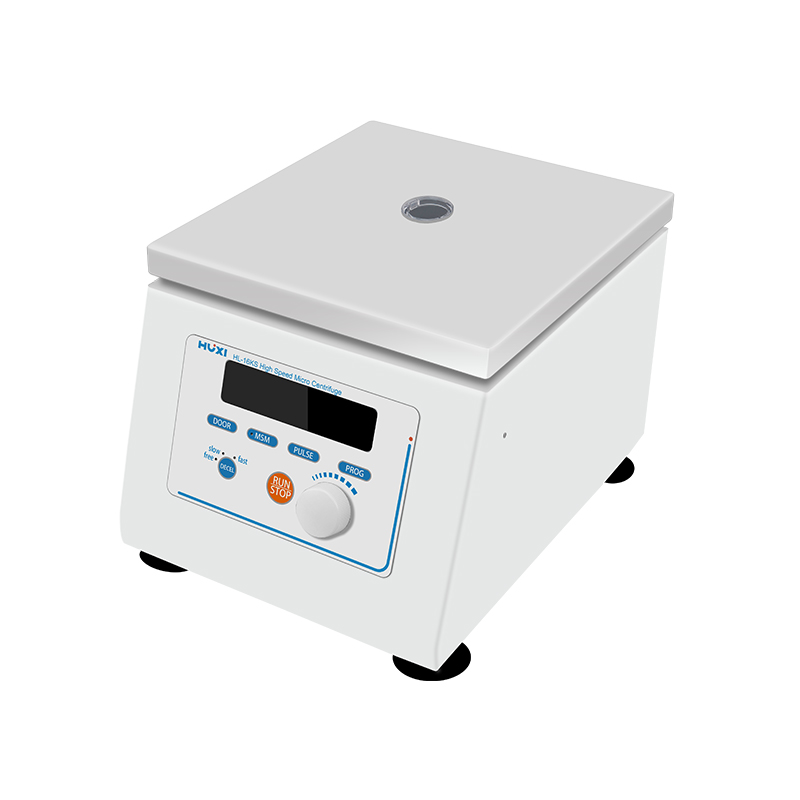
Rotor imbalance poses a severe physical risk. A rotor spinning at high velocity carries immense kinetic energy. A weight difference of just a few grams creates violent vibrations. This vibration destroys motor bearings. It damages the drive shaft.
High-quality units feature automated imbalance detection. They utilize sensitive accelerometers. If they detect dangerous wobble, they trigger an automatic shutoff. You should never purchase equipment lacking these safety interlocks. Always use a precision balance to weigh opposing tubes before starting a run.
Metals experience severe stress during operation. Centrifugal forces stretch and compress the rotor material constantly. This creates microscopic structural fatigue over time. You cannot see this fatigue with the naked eye.
Different materials offer different lifespans. Aluminum rotors are common but degrade faster under heavy use. Carbon fiber rotors resist fatigue exceptionally well. They are lighter and extend motor life. Titanium offers incredible strength for ultracentrifugation. Every rotor has a defined lifecycle. Manufacturers measure this in total runs or years. You must track these cycles meticulously. Retire rotors exactly when specified.
Clean internal cavities regularly to prevent chemical pitting.
Never scratch the protective anodized coating.
Log every spin cycle in a dedicated equipment ledger.
Store rotors in dry, temperature-controlled environments.
Equipment performance drifts over time. Sensors lose accuracy. Motors wear down. This degradation happens silently. If you operate in a regulated environment, strict maintenance is mandatory. Good Laboratory Practice (GLP) and Good Manufacturing Practice (GMP) require proof of performance.
You need verifiable audit trails. Ensure the software offers user-access controls. Operators must log in uniquely. You must schedule routine tachometer calibrations. Temperature probes require regular verification against certified external thermometers. These steps ensure your data remains legally and scientifically valid.
Optimal separation efficiency results from balancing several physical realities. You must understand how relative centrifugal force, sample viscosity, and particle density interact. You cannot rely strictly on rotational speed metrics. By selecting the correct rotor geometry, you drastically improve sample yield and clarity.
Equipment longevity depends on rigorous maintenance. Operators must respect rotor lifecycles, balance loads meticulously, and calibrate sensors frequently. Proper thermal management protects sensitive biological materials from aerodynamic friction.
Before contacting a vendor, document your specific sample profiles. Detail your throughput requirements and facility constraints. This preparation ensures you request the correct technical specifications. You can then confidently book a demo or consult an application specialist to finalize your procurement decision.


