
+86-182-1720-1300 zhaoxuemei1@huxishiye.com
Language
Please Choose Your Language

Views: 0 Author: Site Editor Publish Time: 2026-08-18 Origin: Site


Vortexing remains a foundational lab task everywhere. However, inconsistent sample agitation acts as a hidden driver of downstream data variance. It frequently triggers frustrating assay failures. Researchers often underestimate the physical dynamics inside the tube. This oversight compromises sample integrity.
Many modern facilities are moving away from manual, ad-hoc mixing methods. They increasingly adopt standardized, reproducible protocols. Automation and precision now replace guesswork. You cannot rely on simple visual checks to confirm homogenous mixtures. A rigorous approach demands reliable instrumentation.
Upgrading your mixing equipment requires careful evaluation. You must accurately assess your daily throughput needs. You should also consider sample sensitivity and operator ergonomics. Properly aligning these factors ensures accurate results. It prevents operational bottlenecks. Choosing the right device transforms a mundane task into a reliable scientific step.
Sample preparation dictates the success of every analytical workflow. You cannot expect reliable downstream data if your initial mixture is flawed. Inconsistent agitation directly harms scientific reproducibility. It also strains laboratory budgets.
Poor resuspension of pellets ruins quantitative results. Incomplete homogenization of reagents leaves gradients in your solutions. These errors skew data outputs significantly. You might run a costly PCR or HPLC assay on improperly mixed samples. The resulting data will fail quality control checks. You then face expensive assay reruns. Consumables get wasted. Valuable reagents go down the drain. Over time, these small inconsistencies compound. They generate major financial losses for the laboratory. You must treat mixing as a critical variable.
High-throughput workflows often expose hidden inefficiencies. Relying on single-tube touch-mixing creates severe operational bottlenecks. An operator processing hundreds of vials manually loses hours of productive time. This repetitive motion also increases the risk of Repetitive Strain Injury (RSI). Wrist fatigue leads to shorter, weaker mixing cycles at the end of a shift. The first tube receives vigorous agitation. The hundredth tube barely gets mixed. Operator fatigue directly translates into data variance. You must protect your team from ergonomic strain.
We must define what constitutes a successful mixing protocol. First, it requires reproducible yield across every batch. Second, it demands zero cross-contamination between samples. Third, the procedure must produce verifiable uniformity. Finally, it must guarantee operator safety and comfort. Achieving these criteria requires moving beyond makeshift methods. It requires targeted equipment selection.
Finding the right device depends entirely on your daily applications. You need to align equipment capabilities to your specific needs. An ideal laboratory vortex mixer seamlessly integrates into your existing protocols.
A mini vortex mixer offers a compact footprint. It fits easily inside crowded biosafety cabinets. We highly recommend these units for point-of-care setups. They handle low-volume, quick touch-spin tasks beautifully. You simply press a microcentrifuge tube onto the cup head for instant agitation.
However, this format has clear limitations. They do not suit continuous operations. They lack the motor cooling capacity for extended runs. They also cannot support heavy throughput demands. Use them strictly for intermittent, single-tube applications.
The standard benchtop vortex mixer remains the workhorse of most scientific facilities. It handles general-purpose routine preparation effectively. These devices usually feature dual operational modes. You can select "touch" for quick tasks. You can switch to "continuous" for prolonged extractions.
They boast interchangeable head attachments. You can swap out a standard cup for a flat foam insert. This flexibility accommodates varying tube sizes. They provide a perfect balance of power and versatility for everyday use.
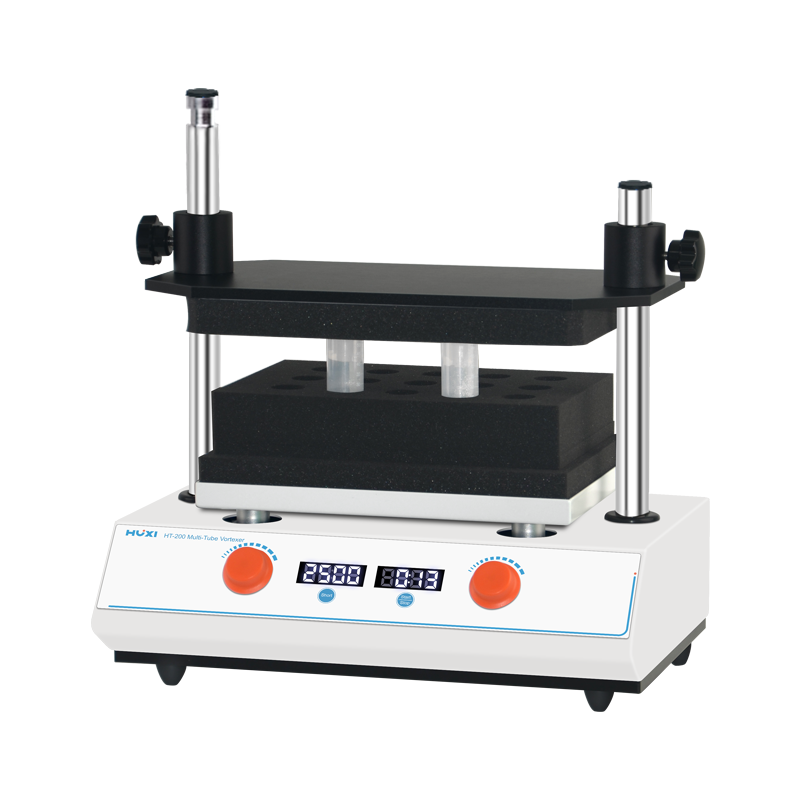
High-throughput environments require robust solutions. A multi tube vortex mixer handles intensive workloads effortlessly. It serves clinical diagnostics and standardized extraction protocols best.
The primary advantage lies in hands-free operation. Operators load dozens of samples into a secure rack. They set the timer and walk away. This simultaneous processing drastically reduces operator fatigue. It slashes preparation time. It ensures every single tube receives the exact same agitation intensity.
Table 1: Comparison of Mixing Equipment Categories
| Equipment Type | Ideal Environment | Throughput Level | Primary Advantage | Key Limitation |
|---|---|---|---|---|
| Mini Series | Biosafety cabinets, small benches | Low (Single tube) | Extremely compact | Cannot run continuously |
| Benchtop Series | General research labs | Medium | Highly versatile | Requires manual swapping |
| Multi-Tube Series | Clinical, high-throughput labs | High (Dozens of tubes) | Hands-free operation | Requires dedicated bench space |
Selecting standard lab equipment goes beyond browsing catalogs. You must evaluate technical specifications against your scientific outcomes. Your chosen Vortex Mixer must deliver consistent mechanical performance.
Many buyers assume higher speeds automatically yield better mixtures. This assumption is scientifically incorrect. Agitation mechanics depend on a delicate balance. Speed (RPM) determines how fast the motor spins. Orbit diameter determines the physical displacement of the liquid.
You need smaller orbits (around 2mm to 3mm) for microplates. Smaller orbits create tight, rapid vibrations. This prevents splashing across shallow wells. Conversely, you need larger orbits (4mm to 5mm) for large conical tubes. A wider orbit forces large liquid volumes up the tube walls. It creates the necessary fluid shear for proper homogenization. Always match the orbit size to your primary vessel.
Motor design directly dictates longevity and noise levels. Older units often utilize brushed DC motors. These motors generate carbon dust. They require periodic maintenance. They also run hotter during continuous use.
Modern equipment frequently uses brushless DC motors. A brushless setup offers significantly quieter operation. It requires zero maintenance. It delivers superior continuous-duty performance. Furthermore, stability is paramount. Assess the base weight of the unit. Check the quality of its suction or dampening feet. Heavy bases prevent the machine from "creeping" across your benchtop. High-speed operations require absolute physical stability.
Your assay requirements will inevitably change. A good device scales alongside your research needs. Evaluate the availability of OEM accessories. Look for customized foam inserts. Check for secure microplate holders. Ensure the manufacturer offers adaptable tube racks.
An interchangeable system extends the utility of your investment. You might process 1.5mL microcentrifuge tubes today. Tomorrow, you may need to mix 50mL conical tubes. A versatile accessory ecosystem prevents you from needing multiple specialized devices.
Even premium equipment fails under improper use. We see operators making avoidable errors daily. These mistakes compromise sample viability. They also damage the machinery. You must train your staff to recognize and mitigate these risks.
Vigorous agitation generates immense physical shear stress. This stress easily shears high-molecular-weight genomic DNA into fragments. It also denatures sensitive protein complexes. Never treat biological macromolecules like simple salt solutions. You must adapt your technique. Use lower speed settings for sensitive biologicals. Employ brief pulse mixing instead of continuous runs. Gentle flicking or inversion sometimes provides a safer alternative.
Safety remains a top priority during high-speed agitation. Operators frequently mismatch foam inserts. They fail to seat tubes firmly into the rack. They apply uncalibrated speeds to loose vessels. This creates a severe operational risk. Tubes can violently eject mid-mix. This leads to broken glass, spilled biohazards, and lost samples. Always verify attachment stability before engaging the motor. Listen for unusual rattling sounds upon startup.
Physics governs the mixing process inside the tube. Efficient homogenization relies on forming a deep "v" shape in the fluid. This vortex draws surface particles down to the bottom. Filling tubes beyond 70% to 80% capacity destroys this mechanism. The liquid lacks the physical headspace to climb the walls. The vortex cannot form properly. You end up with localized agitation near the bottom. The upper liquid layer remains unmixed. Always leave adequate air space in your vessels.
Every facility benefits from strict procedural standardization. Haphazard mixing leads directly to non-reproducible data. You must implement clear guidelines. This drives smarter procurement decisions and better science.
Start by observing your current lab practices. Create a comprehensive baseline. Ask your technicians specific questions. Determine the average daily tube volume. Document the exact tube sizes handled most frequently. Categorize operations into continuous versus intermittent use.
Draft a step-by-step checklist based on these observations. This audit highlights your true operational needs. It prevents you from under-specifying your next equipment purchase. It also prevents overpaying for unnecessary features.
Theory only goes so far. Procurement teams and lab managers must take practical action. We strongly advise you to test drive specific units. Request demo models from distributors. Run them using your actual sample mediums. Viscous buffers behave differently than aqueous solutions.
Consult a specialized application scientist if you run high-throughput integrations. They can help map out robotic compatibility. They can verify orbit specifications for your unique microplates. Real-world testing guarantees protocol alignment before you finalize a purchase.
Selecting appropriate mixing equipment impacts fundamental data integrity. It is not just a generic administrative purchase. Inconsistent agitation ruins sensitive assays. It forces expensive rework. It wastes precious time.
You must prioritize scalable, ergonomically sound solutions. Match equipment specifications strictly to your throughput and volume limits. Always train personnel on proper fluid dynamics. Prevent common errors like over-vortexing and overfilling.
Take time to audit your current procedures. Identify where bottlenecks occur. Test new units using your exact laboratory buffers. By formalizing your sample preparation protocols, you protect your research. You also safeguard your staff against unnecessary repetitive strain.
A: Use touch mode for quick homogenizations. It works perfectly for rapidly resuspending small pellets in single tubes. Use continuous mode for longer protocols. Extended chemical extractions and lengthy dissolving processes require continuous running to ensure absolute uniformity without straining operator wrists.
A: Yes. High-speed agitation creates severe mechanical shear stress. This stress easily shears large genomic DNA into smaller fragments. It also causes protein foaming and denaturation. You must carefully control speed settings. Use short pulse mixing for delicate biologicals to preserve their structural integrity.
A: They serve different physical functions. A vortex generates vigorous, tight, deep-vortex action inside individual tubes. It violently mixes small volumes. An orbital shaker provides gentle, broader horizontal agitation. It suits large flasks, culture plates, and delicate cell suspensions requiring continuous aeration.
A: They often fall short for rigorous protocols. Universal inserts may grip tubes loosely. This causes uneven agitation across the rack. We strongly recommend OEM-specific or precisely engineered inserts. Proper fit prevents tube ejection. It guarantees uniform energy transfer to every sample in the batch.


