
+86-182-1720-1300 zhaoxuemei1@huxishiye.com
Language
Please Choose Your Language

Views: 0 Author: Site Editor Publish Time: 2026-08-19 Origin: Site


Sequential sample preparation creates a persistent bottleneck in modern laboratories. Moving tubes back and forth between a static dry bath and a shaker interrupts your workflow. Worse, this manual transfer risks compromising highly temperature-sensitive reactions. Experimental integrity drops the moment samples experience uncontrolled cooling during transit.
Standard protocols often separate thermal incubation from physical agitation. However, advanced assays demand simultaneous parameter control. Procedures like Western Blot sample preparation or nucleic acid extraction fail when thermal gradients form inside the tube. You must apply heat and kinetic energy concurrently to ensure true experimental reproducibility.
Transitioning from disparate legacy equipment to integrated units marks a critical turning point for lab managers. Upgrading scales up your throughput while enforcing stricter compliance standards. In this guide, we will explore exactly when and why samples require simultaneous heating and shaking to achieve optimal analytical results.
Static heating systems present significant physical limitations. Standard dry block heaters rely entirely on thermal conduction from the block into the vessel wall. From there, heat must travel through the sample via natural convection. Convection alone remains drastically insufficient for rapid, uniform heat transfer. This inefficiency worsens in highly viscous samples, such as crude lysates or genomic DNA suspensions. When you rely solely on a static heater, you inadvertently create thermal gradients. The liquid closest to the plastic wall heats up much faster than the liquid at the center of the tube. In a fully loaded microplate, outer wells often reach target temperatures minutes before the inner wells. This discrepancy introduces unacceptable variability into your assays.
Simultaneous orbital shaking solves this thermodynamic problem. Agitation continuously disrupts the static boundary layer of fluid touching the vessel wall. It forces the cooler central liquid to mix rapidly with the heated outer liquid. This kinetic mixing ensures remarkably even heat distribution throughout the entire sample volume. Rapid heat transfer accelerates reaction kinetics across the board. By combining these forces, you drastically reduce overall incubation times. You also ensure all samples in a batch experience the exact same thermal history.
However, we must recognize practical limits. Not every protocol requires active kinetic mixing. Simple temperature maintenance often succeeds perfectly well with static heating alone. If you only need to keep a buffer warm without catalyzing a reaction, a basic heat block suffices. Integrated units exist specifically for protocols where time-to-temperature and kinetic mixing function as active, critical variables. You should reserve simultaneous processing for assays where uniformity directly dictates data quality.
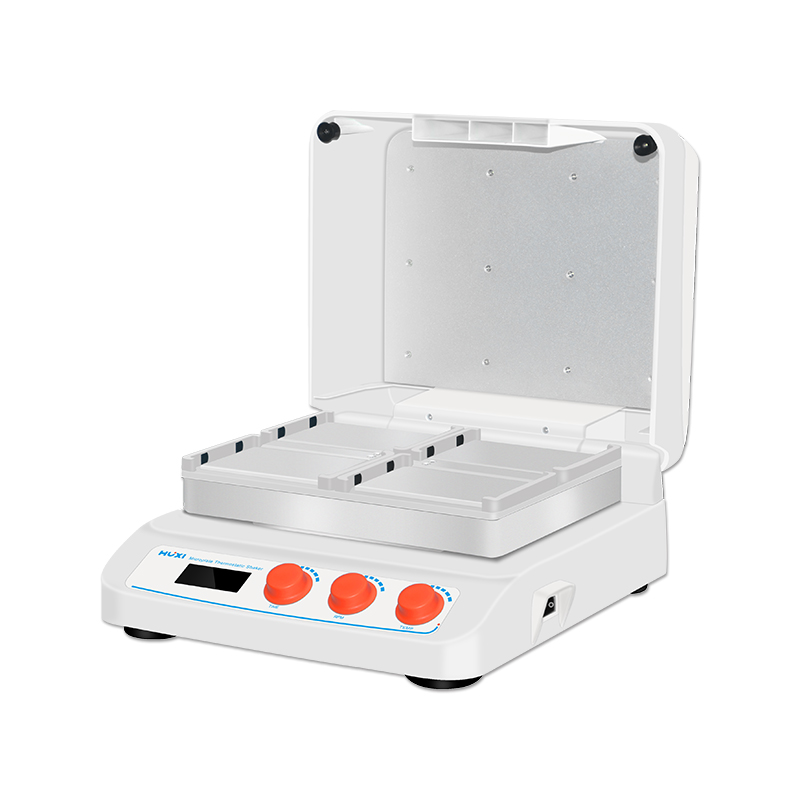
Certain biological protocols strictly depend on combined thermal and kinetic energy. In these applications, processing samples sequentially invites failure. We can categorize the most demanding applications into three primary areas.
Evaluating your laboratory workflow requires looking closely at how equipment dictates human behavior. The legacy approach relies on separate, single-function devices. Technicians typically place a standard laboratory shaker on the bench next to a static water bath or dry block. This setup carries significant hidden costs. Workflow interruptions happen constantly. Technicians must physically move samples between devices at precise intervals. Manual transfer invites human error, missed timers, and temperature drops during transit. Furthermore, running two separate bulky machines consumes valuable premium bench space.
Integrating these functions presents a compelling business case for modern laboratories. An integrated unit allows for highly reproducible, programmable profiles. You can set specific temperature ramps paired with precise RPM changes. This capability creates genuine hands-off walkaway time. Technicians press start and shift their focus to higher-value analytical tasks. Reproducibility climbs because the machine eliminates the variability of human intervention.
We must address the cost-to-benefit reality realistically. Integrated units demand a higher initial capital expenditure than basic static blocks. However, you justify this investment rapidly through improved operational metrics. Better thermal accuracy minimizes sample loss. It reduces the frequency of costly repeat assays caused by inconsistent denaturation or failed lysis. When you factor in the saved technician time and the reduction in wasted expensive reagents, the integrated solution pays for itself.
Comparison of Sample Processing Workflows
| Feature | Traditional Setup (Separate Units) | Integrated Setup (Combined Unit) |
|---|---|---|
| Bench Footprint | Large (Requires two distinct footprint areas) | Compact (Consolidated single footprint) |
| Workflow Efficiency | Low (Requires manual sample transfer) | High (Programmable, walkaway operation) |
| Thermal Consistency | Variable (Cooling occurs during transfer) | Highly uniform (Simultaneous parameters) |
| Reproducibility | Prone to human timing errors | Strict algorithmic control |
Not all integrated devices perform equally. You must evaluate specifications based on your laboratory's most rigorous protocols. Start by examining temperature accuracy and range. Look for systems offering precision down to ±0.5°C. High precision matters immensely for sensitive enzymatic reactions. Additionally, define the importance of sub-ambient cooling for your workflow. Systems equipped with Peltier technology can rapidly cool samples down below room temperature. This rapid cool-down proves essential post-denaturation to snap-chill RNA or halt enzymatic digestions instantly.
Next, scrutinize the agitation mechanics. Orbit size and RPM capabilities dictate mixing efficiency. You must match the orbit size to your primary vessel type. A 2-3 mm orbit operates as the critical standard for a microplate shaker. This tight, rapid orbit ensures deep vortex mixing inside tiny wells without causing splashing. Conversely, larger 15mL or 50mL tubes require wider orbit dynamics to generate a sufficient fluid vortex.
Block interchangeability determines long-term utility. Assess the system's flexibility before purchasing. Can you seamlessly swap a block holding 1.5mL Eppendorf tubes for one designed for a 96-well PCR plate? Quick-release mechanisms save time and prevent technicians from struggling with hot metal blocks. A versatile base unit handles changing lab demands seamlessly over years of use.
Finally, you must evaluate evaporation control mechanisms. High heat drives liquid into a vapor phase. When samples sit in a cold room or an air-conditioned lab, that vapor condenses on the underside of the vessel lid. This condensation drastically changes the concentration of your remaining liquid. Look for anti-condensation features like heated lids. Heated top covers prevent vapor from condensing, returning the liquid to the reaction. This feature is absolutely critical for low-volume PCR plates.
Bringing integrated units into your workflow introduces specific physical risks. High-temperature agitation pushes the limits of standard laboratory plastics and seals. You must train your staff on strict implementation protocols to protect both the samples and the equipment.
Combining heat and agitation goes far beyond simple laboratory convenience. It secures assay reproducibility, drives kinetic efficiency, and protects delicate molecules from thermal stress. Moving away from static dry blocks and isolated shakers removes a major source of human error from your daily workflow.
You should base your equipment evaluation entirely on your specific payload requirements. Determine whether your lab processes more microtubes or microplates, and define the strictness of your thermal uniformity needs. Small orbit sizes suit microplates, while larger orbits benefit conical tubes.
Take time this week to review your highest-volume protocols, particularly tasks like Western Blot sample preparation or high-throughput lysis. Calculate the potential technician time saved by automating the incubation-agitation steps. From there, request a technical demo or review specification sheets for targeted integrated devices to modernize your workflow.
A: Generally, no. While agitation efficiently mixes your running buffer and sample, heat remains physically required to break stubborn hydrogen bonds. Thermal energy unfolds the tertiary structures, allowing the SDS molecules to fully coat the linear protein. You can only skip heating if you are dealing with specific multi-pass membrane proteins explicitly known to aggregate under any heat.
A: Industry best practices strongly lean toward heating. Boiling at 100°C frequently causes complex membrane proteins to aggregate irreversibly, ruining your gel run. Heating samples at 70°C to 90°C for roughly 10 minutes while continuously shaking them provides a much safer, highly reproducible standard for complete denaturation.
A: It clarifies your benchtop but has payload constraints. A combined unit handles 1.5mL tubes, PCR plates, and deep-well microplates brilliantly. However, it is not designed to replace the large, heavy-duty orbital shakers required for multi-liter Erlenmeyer flasks used in scale-up bacterial culturing.
A: Focus entirely on your sealing mechanism and equipment features. Use specialized thermal sealing films designed for high heat, avoiding basic pressure-sensitive adhesives. Furthermore, utilize equipment featuring heated lids. A heated lid prevents temperature differentials, stopping condensation from forming on the top of the plate and ensuring your sample volume remains constant.


