
Language

Views: 0 Author: Site Editor Publish Time: 2026-08-19 Origin: Site


High-throughput sample preparation often reveals a frustrating operational bottleneck in modern laboratories. Technicians frequently spend hours manually processing individual vials. This repetitive single-tube mixing introduces significant sample variability into sensitive assays. It also raises serious risks of repetitive strain injury (RSI) among laboratory staff. Furthermore, manual handling causes critical processing delays downstream. Transitioning from individual handling to batch processing requires careful thought and evaluation. You must balance urgent throughput demands with assay reproducibility and overall sample integrity. This guide offers lab managers and purchasing decision-makers a clear, evidence-based framework. We will help you evaluate exactly when to adopt batch mixing systems over standard manual methods. You will learn about capacity limits, ideal application scenarios, and essential procurement criteria. Our insights will equip you to upgrade your lab workflows safely, consistently, and efficiently.
Every piece of laboratory equipment has a functional threshold. A standard mini vortex mixer excels at quick, on-the-fly agitation. Technicians rely on them for rapid blending of single microcentrifuge tubes before spinning them down. However, this method quickly breaks down under high-throughput conditions. Processing entire 96-well formats or large batches of 15mL and 50mL conical tubes one by one consumes massive amounts of time. You lose precious hours simply holding tubes against a rubber cup.
Human fatigue introduces a severe variability risk into your workflows. A technician processing the fiftieth tube will rarely hold it at the exact same angle as the first tube. The applied downward pressure also fluctuates as wrists tire. These subtle inconsistencies directly impact assay reliability. Quantitative results suffer when mixing times and fluid dynamics vary between technical replicates. You cannot guarantee uniform homogenization when human variables dictate the process.
We must also consider the ergonomic and safety costs associated with sustained manual vortexing. Busy laboratories frequently report occupational hazards related to vibration exposure. Repetitive strain injury (RSI) is a documented risk for technicians who spend hours pressing tubes onto vibrating cups. Protecting staff health is a fundamental operational requirement, not an optional upgrade.
Common signs you have outgrown single-tube mixing:
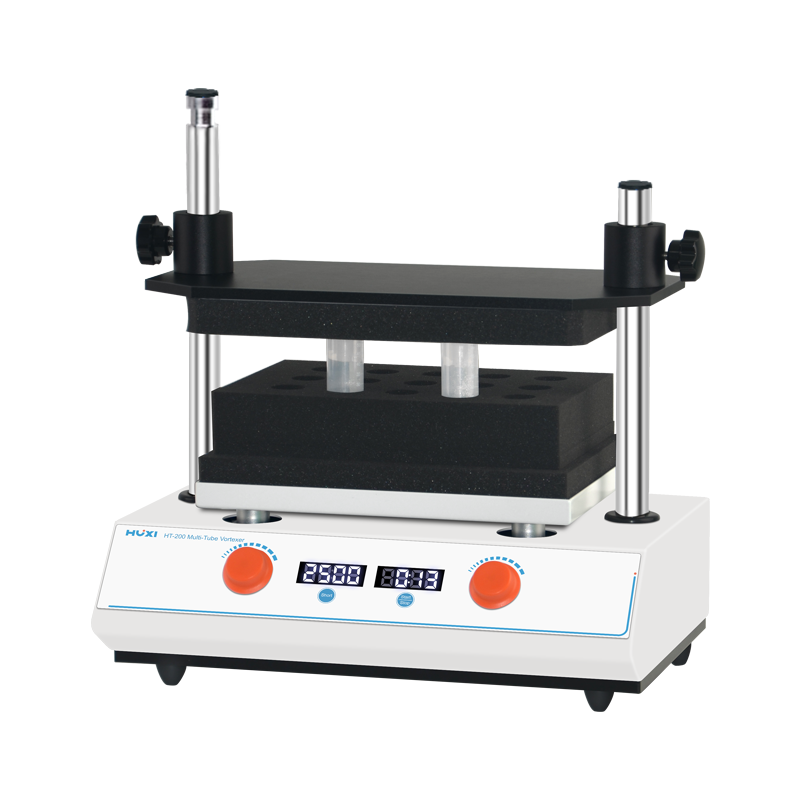
Upgrading to a batch system fundamentally shifts how your lab operates. The most critical advantage is the standardization of agitation. A high-quality multiple tube mixer applies uniform RPM and consistent orbital motion to every single sample simultaneously. Mechanical constraints replace human variables. Every tube experiences the exact same kinetic energy, vortex depth, and fluid sheer. This mechanical uniformity ensures true technical replicates, which improves data integrity across the board.
Walk-away efficiency transforms daily laboratory productivity. Standard manual mixing requires active, hands-on participation from start to finish. Batch processing introduces passive prep time. Technicians load a dedicated rack, secure the top plate, set the digital timer, and walk away. They can spend this time preparing downstream reagents, calibrating analytical instruments, or documenting data. This parallel processing boosts overall laboratory output significantly.
Capacity scaling offers another massive operational benefit. You can increase throughput without sacrificing valuable benchtop space. Standard models easily hold 50 or more microtubes in a single run. They also accommodate custom racks for multiple large-volume tubes or deep-well plates. A single Multi Tube Vortex Mixer occupies roughly the same footprint as a standard centrifuge, yet it processes entire assay batches concurrently.
Best Practices for Batch Mixing Setup:
Bacterial or cellular pellet breakdown requires vigorous, sustained agitation. Centrifugation packs cells tightly at the bottom of the tube. Resuspending these stubborn biological pellets manually tests technician patience and consistency. A batch vortex mixer automates this intense physical requirement. The sustained, high-speed orbital motion forces the buffer into the pellet matrix. This continuous energy breaks down cellular clumps efficiently and evenly across all samples in the batch.
Analytical chemistry and toxicology rely heavily on standardized solvent extractions. Protocols like QuEChERS (Quick, Easy, Cheap, Effective, Rugged, and Safe) demand exact contact time between the sample and the extraction solvent. Manual shaking introduces unacceptable variables in mass transfer rates. Batch mixing guarantees every single sample receives the exact same extraction kinetics. This uniformity is absolutely critical for regulatory compliance and accurate chromatographic analysis.
Heavy buffers, glycerol stocks, and thick polymer solutions resist movement. These viscous reagents require prolonged, continuous vortexing to achieve true homogeneity. Manual vortexing often leaves invisible concentration gradients within the tube. Batch systems overcome this kinematic resistance through relentless, timed agitation. You can program the unit to run for 15 minutes unattended, ensuring complete solute dispersion without straining technician wrists.
Laboratories frequently face a difficult dilemma regarding sample agitation. Vigorous vortexing generates intense shear forces within the fluid column. These sheer forces act as physical scissors, fragmenting high molecular weight (HMW) DNA strands. If you are preparing samples for long-read sequencing or precise qPCR assays, you must avoid aggressive batch vortexing. Delicate enzymes, large templates, and RNA easily degrade under these conditions. Instead, you should rely on gentle flicking, slow pipetting, or specialized low-RPM orbital shaking to preserve sample integrity.
Protein assays carry specific vulnerabilities during sample preparation. High-speed batch vortexing traps air within the fluid matrix. This aeration leads to excessive foaming. The physical stress and air-liquid interface interactions can cause structural degradation and protein denaturation. Specific enzymes lose their catalytic activity when subjected to violent orbital motion. You must evaluate the mechanical stability of your target proteins before committing them to high-speed batch agitation.
Common Mistakes in Sample Agitation:
You must understand the distinct fluid dynamics generated by different laboratory instruments. A laboratory vortex mixer creates an intense, orbital vortex. The fluid climbs the walls of the tube, generating aggressive turbulence. This makes it ideal for rigorous blending, cell disruption, and chemical extractions. Conversely, a rotary mixer relies on gentle, end-over-end inversion. Gravity slowly moves the fluid bubble through the sample.
The decision rule is clear. Choose vortexing for aggressive blending and heavy resuspension tasks. Choose rotation for gentle binding assays, immunoprecipitation protocols, or whole blood mixing where cellular integrity is paramount.
We must also contrast tube-based batch mixing with flat microplate shaking. Microplate shakers focus on tight Z-axis agitation. They utilize a very small orbital diameter at high speeds to move small fluid volumes within shallow wells. Tube mixers utilize a larger orbital diameter to generate a deep vortex in cylindrical tubes. You cannot effectively mix 15mL conical tubes on a microplate shaker, nor should you strap a delicate 96-well PCR plate to a heavy-duty tube vortexer.
Comparison of Laboratory Mixing Modalities
| Mixing Modality | Primary Motion Dynamics | Ideal Sample Types | Relative Shear Force |
|---|---|---|---|
| Batch Tube Vortexing | Large diameter orbital (Vortex) | Cell pellets, solvent extractions, viscous buffers | High |
| Rotary Mixing | End-over-end inversion | Whole blood, binding assays, delicate suspensions | Very Low |
| Microplate Shaking | Small diameter orbital (Horizontal) | ELISA plates, shallow well reactions | Low to Medium |
Purchasing the right equipment requires evaluating specific mechanical and compliance features. Not all mixing units deliver the same long-term reliability. You must assess the engineering quality before integrating a unit into your daily workflows.
Motor Durability & Load Capacity: Investigate the eccentric drive mechanism. The motor must handle fully loaded racks of heavy liquid without stalling. A weak motor will struggle under maximum capacity, leading to incomplete mixing. Furthermore, the unit requires a heavy cast base and strong suction feet. You must ensure the machine does not "walk" across the benchtop when vibrating at 2500 RPM.
Programmable Pulsing: Continuous motion is not always the best approach for stubborn pellets. Look for units offering programmable pulse modes. Pulsing introduces sudden stops and starts, which creates erratic fluid shear. This irregular turbulence disrupts tight bacterial pellets much faster than continuous swirling. Pulsing also helps prevent the motor and the samples from continuous overheating during long runs.
Rack Interchangeability: Future-proof your purchase by evaluating rack versatility. Your lab might process 1.5mL Eppendorf tubes today, but shift to 50mL Falcon tubes or clinical vacutainers tomorrow. Assess whether the manufacturer provides easily swappable foam inserts or durable mechanical racks. Modular systems offer the highest long-term utility.
Calibration & Compliance: Modern, regulated laboratories operate strictly under ISO or GLP guidelines. Standard analog dials fail to meet these strict compliance standards. You need digital speed and time displays. Verification features allow quality control managers to document exact processing parameters. Ensure the unit allows for periodic RPM calibration to maintain operational compliance.
Moving from manual single-tube handling to a multi-tube format represents a strategic operational upgrade. It is not merely a convenience feature for laboratory staff. Batch vortexing enforces strict protocol standardization, ensures technical replicate consistency, and drastically increases daily throughput. It also actively protects your technicians from repetitive strain injuries associated with manual processing.
Your actionable next step is to conduct a thorough audit of your current workflows. Calculate your daily tube volume across different assays. Evaluate the specific sensitivity profile of your target samples to rule out shear-force damage. Once you define these parameters, shortlist specific mixer models based on their motor strength, programmable features, and rack versatility to secure the best fit for your facility.
A: Yes, you can process different tube sizes simultaneously if you use modular foam inserts or adjustable clamping mechanisms. The critical requirement is load balancing. You must distribute the weight evenly across the platform to prevent eccentric wear on the motor and ensure uniform agitation across all samples.
A: Batch mixing prevents cross-contamination primarily through the absence of direct tube manipulation. Technicians do not repeatedly handle the tubes during the mixing phase. As long as you utilize securely sealed caps or tight-fitting pierceable septa, the internal fluid dynamics remain completely isolated within each individual vessel.
A: Generally, no. High-speed vortexing generates significant shear forces that can fragment delicate nucleic acids and denature sensitive enzymes. Unless your specific unit features programmable, highly controlled low-RPM settings, we recommend alternative gentle mixing methods like slow pipetting or inversion for highly sensitive molecular biology applications.


