
+86-182-1720-1300 zhaoxuemei1@huxishiye.com
Language
Please Choose Your Language

Views: 0 Author: Site Editor Publish Time: 2026-08-19 Origin: Site


Standardizing liquid-liquid and solid-liquid extractions faces a critical bottleneck in modern laboratories. Inconsistent agitation frequently leads to highly variable yields. It ruins reproducibility across different sample batches. You simply cannot afford unreliable results in strictly validated analytical workflows. Failed extractions require costly sample reprocessing and waste valuable technician time. Enter the core equipment solution.
General laboratory mixing often relies on simple circular motion. However, vigorous extraction protocols demand intense, directional shear forces. You achieve these aggressive forces by utilizing a Reciprocating Shaker. This distinct motion profile drives optimal solvent interactions. Our guide evaluates essential motion profiles and technical specifications. We also examine implementation risks thoroughly. We will help lab managers select the exact equipment necessary for strictly validated extraction protocols. Discover how to upgrade your standard operating procedures effectively.
Standard agitation methods often struggle during complex workflows. Highly viscous samples resist gentle mixing. Multi-phase mixtures present similar physical challenges. Solute transfer rates stall dramatically under insufficient kinetic energy. You end up wasting time and expensive solvents. A gentle swirl fails to penetrate dense analytical matrices. Solvents remain separated into distinct, unusable layers.
A linear shaker solves this stubborn physical barrier effectively. It generates intense, back-and-forth wave actions. This vigorous sloshing breaks surface tension rapidly. It maximizes the crucial interfacial area between disparate solvents. Chemical interactions occur much faster than they do under gentle swirling. You physically force the solvent into every microscopic pore of the sample matrix.
This aggressive fluid dynamic suits several demanding analytical workflows. Primary extraction applications include:
You must match the fluid dynamic closely to the matrix density. Emulsion risks rise sharply if you apply incorrect motion profiles.
Protocol design dictates your required equipment strictly. You must compare dominant mixing mechanisms objectively. Avoid subjective "better or worse" framing entirely. Each mechanical design solves a completely different physical challenge.
An orbital shaker performs exceptionally well for specific biological tasks. It is best for aeration and gentle cell culture growth. It maintains fragile cell suspensions effectively. You use it for low-shear mixing in Erlenmeyer flasks or microplates. However, rigorous extraction workflows expose its structural limitations. Low orbital speeds often create a "vortexing dead zone." This dead zone sits right in the center of certain flat-bottom vessels. Samples simply spin around without mixing deeply. Incomplete solvent interaction ruins your total extraction yield.
Conversely, a reciprocating lab shaker attacks tough matrices head-on. It is best for vigorous, high-shear mixing. You use it for rapid solvent extraction workflows. It excels at breaking down tough biological or environmental matrices. The extraction advantage lies in its precise linear geometry. Consistent end-to-end agitation eliminates dead zones entirely. It ensures equal shear force distribution across the entire platform. Every sample replicate experiences identical kinetic forces. You achieve perfect reproducibility across all analytical replicates.
| Mechanism Focus | Optimal Workflow Applications | Shear Force Level | Known Technical Limitations |
|---|---|---|---|
| Orbital Motion | Bacterial cultures, aeration, staining | Low to Moderate | Vortex dead zones at low RPM |
| Linear Motion | LLE, EPA soil testing, QuEChERS | High to Very High | Not suitable for fragile cells |
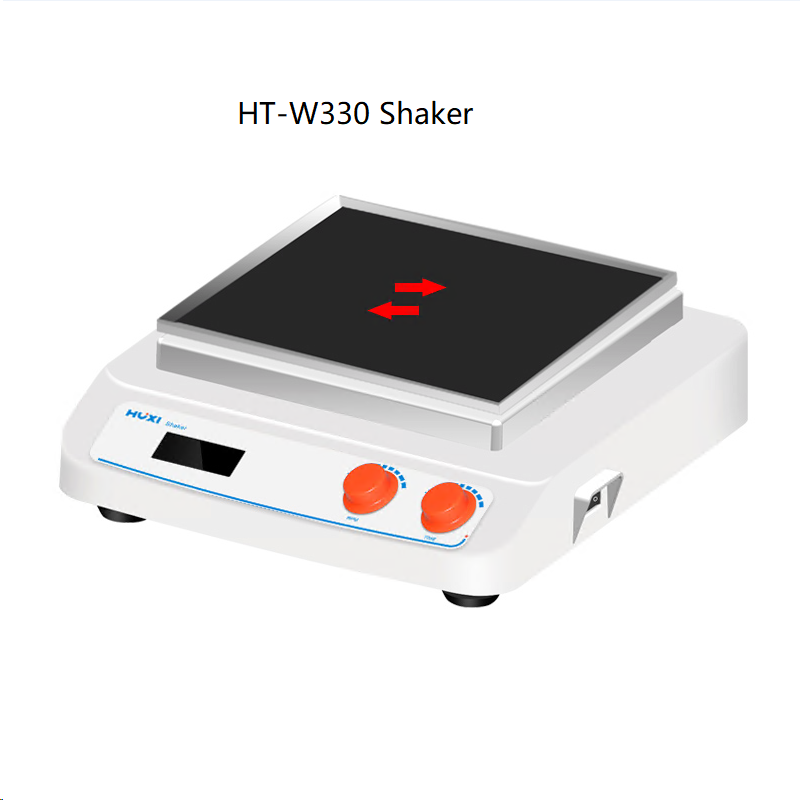
Buyers must evaluate specific technical parameters carefully. Features must map directly to expected experimental outcomes. You must ensure the equipment meets your standard operating procedures (SOPs). A poor specification mismatch causes frequent protocol failures and wasted materials.
Stroke length defines the physical travel distance of the platform. It dictates the intensity of the internal fluid wave. Longer strokes range from 20mm to 30mm. These longer travel paths at moderate speeds suit large separatory funnels perfectly. They generate massive fluid momentum across long vessels. Shorter strokes operate quite differently. They typically travel between 4mm and 10mm. You pair short strokes alongside high operational speeds. This combination suits micro-volume extractions in small test tubes. It prevents violent splashing while maintaining rapid mass transfer rates.
Precise RPM control remains strictly necessary for consistent results. Liquid-liquid workflows present a unique kinetic challenge. You must find the exact "sweet spot" for agitation. Too slow, and solvent extraction takes hours. Too fast, and you create unbreakable emulsions. High kinetic energy fractures the aqueous phase into microscopic droplets. High-end units offer single-RPM adjustment increments. This precision lets you optimize mass transfer safely. You avoid ruining hours of expensive prep work.
Lab managers often misunderstand critical payload specifications. There is a vast difference between "maximum payload" and "maximum operational payload at peak RPM." Heavy solvent loads strain drive motors immensely. Sub-par models suffer significant speed degradation under heavy physical loads. A 10kg load might drop maximum speed by 30%. You must verify the speed rating at your specific payload weight. Otherwise, your extraction forces will drop unexpectedly during operation.
Deploying continuous-duty shakers introduces distinct laboratory realities. High-throughput labs push equipment to absolute structural limits. You must approach procurement utilizing evidence-oriented skepticism.
Aggressive reciprocating motion generates massive physical stress internally. It causes faster belt and motor wear than circular motion. The abrupt direction changes constantly fight heavy inertia. We highly recommend evaluating internal drive designs thoroughly. Look closely for brushless DC motors. They eliminate carbon brush degradation entirely. Triple-eccentric drive mechanisms ensure long-term operational longevity. They distribute massive kinetic loads evenly across multiple bearings. Single-eccentric designs often fail under heavy, continuous analytical use.
Unbalanced loads create serious safety hazards in busy labs. Heavy solvents shifting violently cause equipment to "walk." The unit slowly moves across your benchtop. It might eventually fall off completely. You must always balance sample weights symmetrically across the platform. Look for advanced models featuring auto-imbalance detection. These vital sensors automatically cut motor power during dangerous imbalances. Alternatively, select units featuring heavy cast-iron bases. The sheer mass dampens sympathetic vibrations effectively.
Many protocols require specific thermal ambient conditions. You might deploy equipment inside a walk-in cold room. You might place it inside a heated incubator. These extreme environments stress internal electronic components. Assess the humidity and condensation ratings carefully. Condensation ruins exposed circuit boards quickly. Additionally, consider the thermal output of the shaker motor itself. Inefficient motors generate significant waste heat. This unexpected heat transfers upward through the platform. It can unintentionally degrade temperature-sensitive sample integrity.
You need a structured decision framework for equipment selection. Moving from evaluation to procurement requires strict analytical logic. Guesswork leads directly to frustrating workflow bottlenecks.
Analyze your baseline metrics first. Is your current yield simply too low? Is your processing time far too slow? Identify the exact failure point accurately. A transition to linear motion becomes required if aggressive shear forces are lacking. Do not replace equipment without understanding the root failure mechanism.
You must match platform accessories perfectly. Separatory funnel clamps hold awkward glassware securely. Flask clips secure Erlenmeyer geometries. Microplate holders clamp standard assay plates tightly. Ensure the specific laboratory shaker model supports your required clamp mix. Some brands force you into proprietary, inflexible accessory ecosystems. You want maximum accessory versatility.
Never commit capital funds without empirical proof. We strongly recommend requesting a demo unit first. Run a side-by-side extraction yield analysis. Compare the new unit directly against your current legacy equipment. Measure the analyte recovery rates precisely. Log the exact processing times. This objective data proves the investment value entirely.
Follow this specific sequence for successful procurement:
Standardizing extraction yields requires a fundamental physical alignment. You must match the physical motion of the equipment to the chemical realities of your matrix. Ignoring this crucial relationship guarantees highly variable results. You compromise your entire analytical pipeline.
Remember, durable drive mechanisms remain paramount for continuous operations. Precise stroke and RPM calibration define true protocol success. Superficial aesthetic designs offer zero practical laboratory value. High-quality brushless motors and triple-eccentric drives prevent catastrophic workflow interruptions entirely.
Take immediate action today to optimize your yields. Review your specific extraction SOPs thoroughly. Consult directly with a technical specialist. They will help you match stroke length and platform capacity accurately. Align these exact specifications perfectly to your highest-volume analytical workflows.
A: Generally, no. The high shear forces and wave action are usually too aggressive for mammalian or fragile microbial cells. These cultures prefer the gentle aeration of an orbital shaker. However, you can use reciprocating models for specific robust cell lysis protocols.
A: Stroke length should scale directly with vessel size and required agitation intensity. Shorter strokes (10-15mm) are better for small tubes to prevent spills. Longer strokes (20-30mm+) are entirely necessary to achieve proper wave motion inside large flasks or separatory funnels.
A: Asymmetrical loading of heavy solvents causes immediate vibration issues. Exceeding the manufacturer's maximum speed rating for a specific payload weight also triggers walking. Always balance samples symmetrically. Look closely for modern models featuring out-of-balance sensors and automatic speed reduction capabilities.


