
+86-182-1720-1300 zhaoxuemei1@huxishiye.com
Language
Please Choose Your Language

Views: 0 Author: Site Editor Publish Time: 2026-08-14 Origin: Site


Mixing high-viscosity samples that are highly sensitive to shear stress creates a direct conflict in laboratory workflows. Concentrated biological suspensions, liquid-solid suspensions, polymer gels, and coagulating blood demand thorough dispersion to maintain uniformity. Traditional high-shear mixers force this dispersion but destroy sample integrity. They cause immediate hemolysis in whole blood and degrade delicate polymer chains in chemical formulations. On the other end of the spectrum, a standard laboratory shaker lacks the mechanical force to move high-centipoise fluids. This results in severe fluid stratification and rapid particulate settling. We need to determine if benchtop roller mechanisms—traditionally built for low-viscosity liquid-liquid mixing—can deliver the required kinetic energy for viscous fluids without generating destructive shear forces. This evaluation covers mechanical limits, configuration requirements, and alternative technologies for handling heavy laboratory samples.
Achieving successful sample homogenization requires meeting strict baseline criteria. You must achieve homogeneous dispersion across the entire sample volume without altering physical or biological properties. Keeping particulates fully suspended in viscous liquid-solid mixtures proves exceptionally challenging in daily lab operations. Gravity constantly pulls heavier solid particles downward toward the tube bottom. Thick fluids actively resist the kinetic energy required to lift these particles back into suspension. Lab technicians must balance the mechanical force applied against the inherent fragility of the suspension.
We define successful mixing for sensitive viscous samples through four specific baseline requirements:
Complete homogenization of the sample volume without dead zones.
Zero alteration or degradation of cellular membranes and molecular structures.
Continuous, even suspension of solid particulates throughout the fluid matrix.
Maintenance of thermal stability, avoiding friction-induced temperature spikes during agitation.
Fluid resistance dictates the exact mechanical force required for movement. We measure this fluid resistance in centipoise (cP). High viscosity inherently dampens the kinetic energy provided by standard mixing equipment. Traditional mixing becomes increasingly difficult as the centipoise rating rises. The thick fluid absorbs the mechanical input rather than flowing naturally. This resistance forces operators to apply more aggressive agitation to achieve any visible movement. Newtonian fluids maintain constant viscosity regardless of agitation. Non-Newtonian fluids change viscosity under stress, complicating the mixing process further.
Applying aggressive mechanical force introduces severe risks to sample integrity. High-shear mixing physically tears fragile cellular components apart. In clinical diagnostic settings, aggressive shaking causes rapid hemolysis. This action ruptures red blood cells and ruins diagnostic accuracy completely. In chemical formulations, excessive shear stress breaks delicate molecular chains permanently. You lose the intended structural properties of expensive polymer gels. Gentle handling remains an absolute necessity for preserving these sensitive materials during preparation.
Understanding the exact nature of shear stress helps clarify the mechanical challenge. Shear stress occurs when adjacent layers of fluid move at different velocities. In a high-speed orbital mixer, the fluid near the wall moves violently while the center lags. This velocity gradient rips cellular membranes apart. Red blood cells possess a fragile lipid bilayer that cannot withstand these gradients. When processing whole blood, the goal is to keep the cells suspended in plasma without creating these destructive velocity differences. Viscous polymer gels face similar structural threats. Long-chain molecules tangle together to create the gel's thick consistency. High-shear blades slice through these tangles, permanently reducing the fluid's viscosity and ruining the formulation.
Understanding the mechanical action reveals why certain devices excel with specific fluids. Pure rolling creates a simple cylindrical vortex inside the sealed vessel. This vortex works exceptionally well for basic, low-viscosity fluids like water or light buffers. However, it fails to suspend particles in thicker suspensions. Adding a specialized rocking mechanism introduces a Z-axis tilt to the rotation. This dual action functions as a highly effective rock shaker. The combination creates complex, three-dimensional mixing patterns. These patterns prove highly versatile and prevent heavier, viscous components from settling at the tube ends.
Contrast this gentle action with traditional laboratory equipment. The continuous wave motion provides extremely gentle, low-impact agitation. Vortexers rely on aggressive, high-speed orbital rotation to force fluid movement. Standard platform shakers use vigorous linear agitation to shake samples back and forth. These aggressive methods generate high, localized shear forces within the fluid. They destroy fragile cellular structures rapidly upon contact. The synchronized rolling and rocking action completely avoids these destructive physical impacts.
Consider the blood tube mixer as the primary example of this technology in action. Manufacturers calibrate its specific RPM and tilt angle specifically for whole blood processing. Whole blood acts as a non-Newtonian, moderately viscous fluid. It requires constant, steady motion to prevent rapid coagulation. It also demands exceptionally low shear to prevent hemolysis. The calibrated rolling action meets both stringent clinical requirements perfectly.
The physical construction of the rollers heavily influences the mixing efficiency. High-quality devices utilize rollers coated with high-friction materials like polyurethane or specialized PVC. This friction grips the exterior of the plastic or glass tubes securely. Without adequate friction, heavy tubes simply slip on the rotating cylinders. The rocking mechanism operates via an eccentric cam system connected to the drive motor. As the rollers turn, one end of the platform rises and falls rhythmically. This elevation change forces the viscous fluid to travel longitudinally down the tube. When combined with the radial rotation, the fluid undergoes a continuous, gentle folding process. This three-dimensional movement ensures that heavier particulates cannot settle in the tube's dead zones.
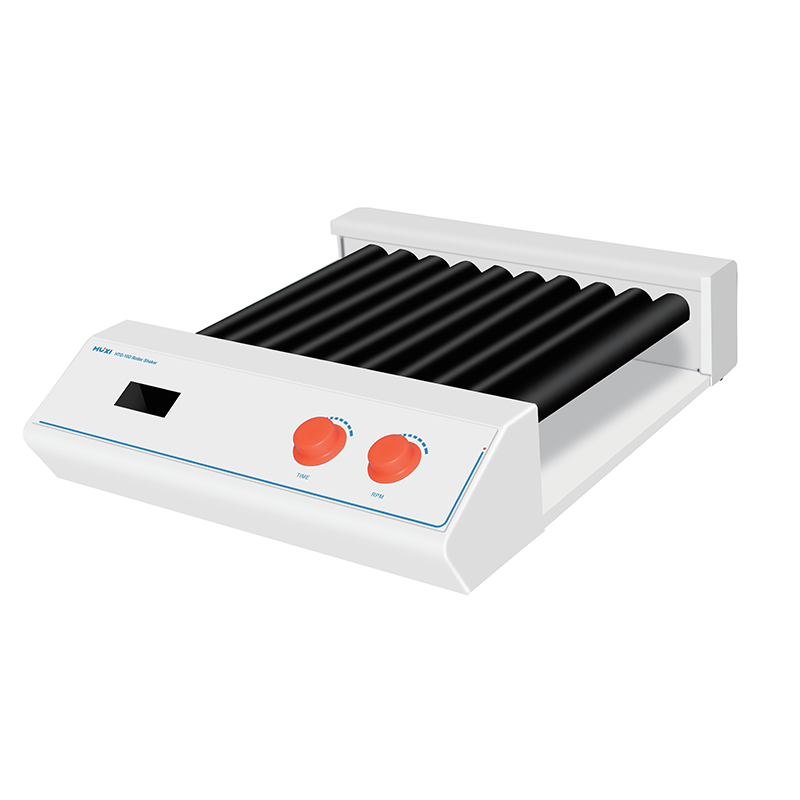
Evaluators must look far beyond basic RPM specifications when selecting equipment. Motor torque dictates the actual handling capacity for thick, resistant fluids. Heavy, viscous samples place immense mechanical strain on benchtop instrument motors. You need advanced stepper motors or high-torque continuous-duty motors for reliable operation. Weak motors stall immediately when loaded with dense liquid-solid suspensions. Stalling ruins the sample batch and damages the equipment permanently. Always verify the maximum load capacity before processing heavy gels or dense slurries.
Fluid dynamics inside the sealed tube dictate your mixing success entirely. A tube roller shaker requires adequate headspace to function properly. You must leave a sufficient air gap inside the vessel. This gap allows the viscous fluid to fold over itself during rotation. Overfilling the tube completely neutralizes the internal mixing action. The fluid cannot move internally due to lack of space. It simply rotates as a solid mass against the tube walls, achieving zero dispersion.
Variable speed controls and adjustable tilt angles provide necessary operational flexibility. Most quality units offer programmable speeds ranging from 10 to 100 RPM. Highly viscous samples almost always require much slower rotation speeds. Slow movement gives the thick fluid adequate time to respond to gravity. Fast rotation pins the viscous material against the outer walls via centrifugal force. You must match the rotation speed to the fluid resistance perfectly to achieve internal folding.
Selecting the correct tube size impacts the fluid dynamics directly. Narrow tubes restrict the movement of high-centipoise fluids severely. The fluid surface tension bridges the narrow gap, preventing any internal folding. Wide-mouth tubes or larger cylindrical vessels provide the necessary internal geometry for thick fluids to shift. The angle of the rock also requires careful consideration. A steep tilt angle forces the fluid to move aggressively from end to end. A shallow angle provides a more subtle longitudinal shift. Operators must balance the tilt angle with the rotation speed. A fast rotation combined with a steep tilt often creates too much turbulence for fragile samples.
To ensure optimal fluid dynamics when processing high-viscosity samples, follow this standardized loading procedure:
Verify the sample viscosity falls within the equipment's operational limits.
Select a wide-mouth vessel to minimize surface tension bridging across the tube diameter.
Fill the vessel to a maximum of 60 percent capacity to guarantee adequate headspace for fluid folding.
Distribute the tubes evenly across the roller platform to balance the mechanical load on the drive motor.
Set the initial rotation speed to the lowest available setting and observe the internal fluid movement.
Gradually increase the RPM until the fluid folds continuously without pinning against the tube walls.
Every mechanical device possesses strict operational limits based on physics. You must define the exact centipoise threshold for your specific laboratory application. Beyond a certain viscosity, gentle mixing transitions into completely ineffective rotation. The sample stops folding internally and locks into place. It simply rotates as a solid mass inside the tube. When you observe this solid mass rotation, the current method has failed. You must transition to a more powerful mixing technology immediately to salvage the process.
Blade-based mixing offers a standard solution for high-viscosity pastes. Overhead stirrers and vertical mixers drive metal impellers through thick materials. A vertical mixer provides excellent mixing only under specific mechanical conditions. The product must move mechanically to create internal eddies and flow patterns. However, this method introduces a severe operational trade-off. The metal blades generate massive, localized shear stress. This stress easily damages fragile biological components and tears delicate polymer structures apart.
Non-contact technologies provide another viable alternative for highly sensitive materials. Acoustic and resonant mixers handle extremely high-viscosity applications effectively. These advanced devices use low-frequency acoustic energy to achieve thorough dispersion. They operate entirely without impellers, blades, or internal moving parts. This design eliminates localized shear stress hot spots completely. Acoustic mixing remains highly suitable for the most sensitive, heavy pastes in advanced laboratory settings.
Detailing the specific viscosity ranges clarifies equipment selection. Water represents 1 cP. Whole blood ranges from 3 to 5 cP under normal conditions. Light oils reach 100 cP. Glycerin sits around 1,000 cP. A standard benchtop Roller Shaker handles fluids up to approximately 1,000 cP effectively. Beyond this point, the fluid acts more like a soft solid. Honey, for example, measures around 10,000 cP. If you place a tube of honey on a standard roller, the honey will simply stick to the tube walls. It will rotate in a complete circle without any internal mixing. This phenomenon represents the absolute operational limit of the technology. When dealing with 10,000 cP and above, you must abandon rolling mechanisms entirely.
Operational Parameters for Viscous Fluid Mixing
Technology Type | Optimal Viscosity Range (cP) | Shear Stress Profile | Primary Lab Application |
|---|---|---|---|
Rolling and Rocking Mechanisms | 1 to 1,000 | Extremely Low | Whole blood, fragile cell suspensions, light gels |
Overhead Impeller Stirrers | 1,000 to 50,000 | High | Heavy chemical pastes, robust polymer formulations |
Acoustic Resonant Mixers | 10,000 to 100,000+ | Low | Highly sensitive energetic materials, ultra-dense gels |
Implement the following actions to optimize your viscous sample mixing protocols immediately:
Run a baseline viscosity test on all new sample types using a controlled 50mL conical tube with 40 percent headspace to verify internal fluid folding.
Audit your current motor specifications to ensure they utilize high-torque stepper motors before loading dense liquid-solid suspensions onto the platform.
Establish a standardized fill-line protocol for technicians to prevent overfilling and subsequent solid mass rotation.
Schedule quarterly amplitude and RPM calibration checks to maintain consistent longitudinal fluid movement.


