
+86-400-808-1508 zhaoxuemei1@huxishiye.com
Language
Please Choose Your Language

Views: 0 Author: Site Editor Publish Time: 2025-11-03 Origin: Site


A lab homogenizer uses mechanical force to blend and break down samples for precise sample preparation, while a high pressure homogenizer applies intense pressure to achieve dramatic particle size reduction. Researchers choose a lab high shear homogenizer for small volumes and delicate samples, often in molecular biology, whereas high pressure homogenizers excel in industrial-scale sample preparation. Selecting the right homogenizer impacts process efficiency, product stability, and sample integrity across laboratory and manufacturing environments.
Lab high shear homogenizers use fast mechanical mixing to break down particles in small samples, ideal for precise lab work and delicate materials.
High pressure homogenizers apply intense pressure to create ultra-fine particles, making them perfect for large-scale industrial production and stable emulsions.
Choosing the right homogenizer depends on sample size, desired particle size, and application needs; lab homogenizers suit small volumes, while high pressure homogenizers handle large volumes.
High shear mixing offers fast, energy-efficient processing with easy cleaning, while high pressure homogenizers provide better control over particle size but require more maintenance.
Advances like microfluidizer technology and automated systems improve reproducibility, scalability, and efficiency in both lab and industrial homogenization.
A lab high shear homogenizer is a specialized device designed for laboratory-scale sample processing. This homogenizer uses a high-speed rotor and stator system to create intense shear forces. The rotor spins rapidly inside the stator, drawing liquid through a narrow gap. This action generates a high shear zone, breaking down particles and droplets to produce a uniform mixture. Some models, like the ShearJet processor, use microchannels in a fixed Reaction Chamber to achieve even finer particle size reduction. These devices can reach velocities up to 500 m/s and pressures between 5,000 and 30,000 psi. The lab high shear homogenizer excels at creating nanoemulsions and dispersions with narrow particle size distribution. Efficient cooling systems help maintain sample integrity during processing. Compared to other homogenization techniques, the lab high shear homogenizer often requires fewer passes to achieve the desired result. Researchers use this equipment for applications such as cell disruption, nanoparticle dispersion, and formulation of stable emulsions.
Tip: A laboratory high shear mixer is ideal for small-volume, high-precision tasks where sample consistency and reproducibility matter.
A high pressure homogenizer uses a powerful pump to force fluids through a narrow gap at extremely high pressures, often between 8,000 and 40,000 psi. This process creates intense shear, impact, and cavitation forces that break down particles to submicron or even nanometer sizes. The table below summarizes key principles and aspects of high pressure homogenizers:
Principle / Aspect | Description |
|---|---|
Shearing | Mechanical friction between fluid layers reduces particle size. |
Cavitation | Vapor bubbles form and collapse, producing shockwaves that disrupt particles. |
Turbulence | Chaotic fluid motion further breaks droplets and particles. |
Operating Mechanism | Positive displacement pump with pistons or plungers stabilizes flow and pressure. |
Applications | Used in food, pharmaceuticals, and chemicals for emulsification, cell lysis, and nanoemulsions. |
High pressure homogenizers can be direct-drive or intensifier types, with the latter achieving higher pressures and better durability. These homogenization systems are essential for industrial-scale production where ultra-fine particle size and product stability are critical.
A lab homogenizer is a general term for devices that mix, emulsify, or disperse samples in laboratory settings. These devices use various mechanisms, including rotor-stator assemblies, bead mills, ultrasonic probes, and automated platforms. The main goal is to reduce particle size and create uniform mixtures. The table below outlines the main features:
Aspect | Description |
|---|---|
Definition | Mechanical device for mixing, emulsifying, and dispersing materials. |
Components | Rotor-stator, bead mill, ultrasonic probe, or automated system. |
Working Principle | High-speed mechanical force or cavitation disrupts particles. |
Output | Homogeneous mixture with improved stability. |
Types | Batch, inline high shear mixer, ultrasonic, and bead mill. |
Lab homogenizers support a wide range of applications, from pharmaceutical development to food science research. They offer significant particle size reduction, improved sample consistency, and faster preparation times. The high shear mixer and inline high shear mixer are common choices for researchers needing efficient and reproducible results.
A high shear homogenizer plays a vital role in laboratory sample preparation. Scientists use this device to create nanoemulsions and nanoencapsulations for pharmaceutical research. The high shear mixer, with its rotor-stator design, breaks down particles and disperses them evenly. Researchers often select this equipment for cell disruption, tissue homogenization, and extraction of proteins, DNA, and RNA. These processes support genomic and biomolecular studies. In food science, the high shear homogenizer helps with liquid-liquid emulsification, ensuring product consistency and stability. Industrial high shear mixer models also find use in chemical and cosmetic labs for particle size reduction and dispersion of pigments. This technology improves the quality of creams, lotions, and suspensions.
Note: High shear homogenizers can process tough plant materials and complex samples, making them valuable for environmental and agricultural research.
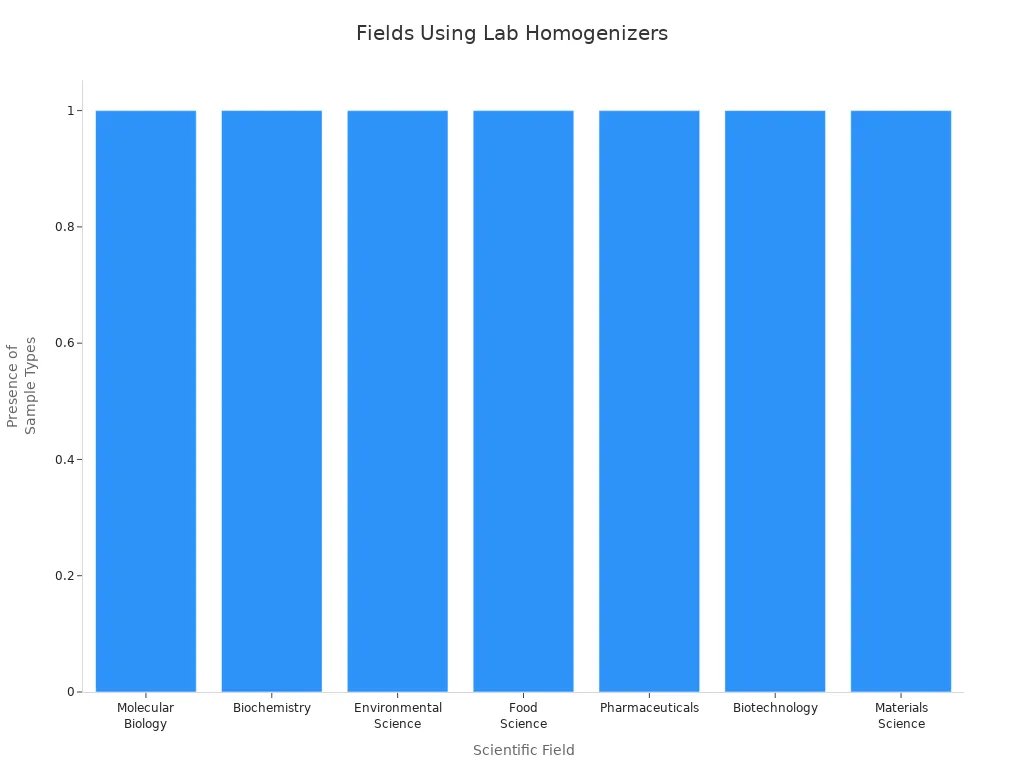
A lab homogenizer serves many scientific fields. Molecular biology labs use it for cell lysis and extraction of genetic material. Pharmaceutical labs rely on this tool for uniform distribution of active ingredients during sample preparation. Environmental scientists process soil and plant samples to test for contaminants. Food scientists use lab homogenizers to analyze milk, juices, and sauces. The table below shows common fields and sample types:
Scientific Fields | Typical Sample Types | Common Applications |
|---|---|---|
Molecular Biology | Tissues, cells, cultures | DNA, RNA, protein extraction |
Biochemistry | Tissues, cells | Enzyme extraction, protein analysis |
Environmental Science | Soil, plant materials | Environmental testing |
Food Science | Creams, milk | Food and beverage production |
Pharmaceuticals | Suspensions | Drug formulation, ingredient distribution |
Biotechnology | Cells, tissues | Cell lysis, nucleic acid extraction |
Materials Science | Mixtures | Stable emulsions, suspensions |
A high pressure homogenizer supports large-scale sample preparation in pharmaceutical, food, and chemical industries. This device excels at mechanical disruption of particles and emulsification. Pharmaceutical research teams use it to create nanoemulsions and ensure uniform drug formulations. The high pressure process allows for continuous operation and consistent results, even with large volumes. Industrial labs use this homogenizer for dispersing pigments in paints, preparing stable emulsions for lubricants, and processing slurries. The ability to fine-tune process parameters makes it ideal for applications that demand precise control and product integrity.
Tip: High pressure homogenizers outperform bead homogenizers for industrial-scale tasks due to their efficiency and scalability.
Selecting the right homogenization technology depends on understanding the strengths and weaknesses of each device. Both lab homogenizers and high pressure homogenizers offer unique benefits for sample preparation in pharmaceutical, food, and chemical industries. The table below summarizes the main advantages and limitations:
Aspect | Lab Homogenizers (Wet Milling) | High Pressure Homogenizers |
|---|---|---|
Economic Value | Economically advantageous | Economically advantageous |
Scalability | Easy to scale up | Easy to scale up |
Contamination Risk | Higher due to erosion of mill balls causing residues | Lower, no mill balls used, reducing contamination |
Particle Size Control | Less customizable | Customizable settings allow better control |
Process Mechanism | Uses milling balls in a liquid medium | Forces sample through narrow tube at high pressure |
Lab homogenizers, especially those using high-shear processing, are easy to use and clean. They handle small to medium sample volumes and support rapid sample preparation. However, contamination risk increases when using bead mills or wet milling due to erosion of the grinding media. High-shear mixers, such as the rotor stator homogenizer, avoid this issue and provide consistent results for emulsions and dispersions.
High pressure homogenizers excel at producing ultra-fine, uniform particles. They offer precise control over particle size, which is critical for pharmaceutical research and industrial applications. These devices can process large liquid volumes continuously, making them ideal for scale-up. However, they require more time for setup and cleaning, and they are less practical for small sample volumes or high-throughput needs. The cleaning process is labor-intensive, and the equipment is heavy and expensive.
Note: High pressure homogenization can generate significant heat, which may affect temperature-sensitive samples. Most studies show that short processing times limit thermal degradation, but users should monitor sample temperature during operation.
The following table highlights additional operational differences:
Feature | Lab Homogenizers (Rotor Stator) | High Pressure Homogenizers (HPH) |
|---|---|---|
Throughput | Low, suited for small samples | Low, but can handle continuous feeding for large volumes |
Scalability | Easy to scale up, but limited to smaller volumes | Highly suitable for industrial scale-up |
Sample Size Range | Very small (0.03 mL and up) | Larger minimum sample size (~10 mL and up) |
Ease of Use | Easier to use and clean, better for multi-sample | More complex setup and cleaning |
Industrial Suitability | Better for research and small scale applications | Ideal for industrial applications requiring reproducibility and scalability |
High-shear processing in lab homogenizers offers energy efficiency and reduced waste, especially when compared to traditional stirring methods. Automated homogenization systems further improve process efficiency, reduce errors, and minimize waste generation in industrial settings.
Selecting the best homogenizer for a specific application involves several important criteria. The following list outlines key factors to consider:
Purpose of the Homogenizer: Determine if the need is for research and development (lab scale) or manufacturing (industrial scale). Lab high shear homogenizers are ideal for R&D, while high pressure homogenizers suit large-scale production.
Desired Particle Size: High pressure homogenizers achieve the smallest and most uniform particle sizes, which is essential for pharmaceutical and cosmetic products requiring long-term stability. High-shear mixers work well for coarser emulsions and rapid mixing.
Sample Volume and Throughput: Lab homogenizers handle small to medium volumes efficiently and allow for quick sample changes. High pressure homogenizers process large liquid volumes continuously but are less practical for small batches or high-throughput needs.
Sample Type: High pressure homogenizers are best for liquid samples. Lab homogenizers, including rotor stator homogenizers and bead mills, can process solids, suspensions, and viscous materials.
Process Control and Customization: High pressure homogenizers offer more customizable settings for particle size and process parameters. Automated homogenization systems provide precise control and reproducibility.
Cost and Maintenance: High pressure homogenizers require higher initial investment and maintenance costs. Lab homogenizers are more affordable, easier to clean, and better suited for frequent use with small samples.
Cleaning and Maintenance: Lab homogenizers require cleaning of rotor-stator assemblies, often using ultrasonic cleaning for thoroughness. High pressure homogenizers need regular cleaning and lubrication of pumps and valves, with frequent replacement of wear parts.
Environmental Impact: Automated homogenization and high-shear processing technologies help reduce waste and energy use by optimizing process parameters and minimizing errors.
Tip: Always match the homogenization method to the sample type, desired particle size, and application needs. For pharmaceutical research, where precise particle size and sample integrity matter, high pressure homogenizers or advanced lab high shear homogenizers with automated homogenization features provide the best results.
The desired particle size remains a key factor. High-shear mixers rapidly reduce particle size and disperse particles for emulsions and suspensions with larger particles. High pressure homogenizers break particles down to microscopic or nano scales, improving product stability and texture. For applications like serums or light lotions, where long-term stability is critical, high pressure homogenization offers superior results.
When considering scale-up, users should note that lab homogenizers and high pressure homogenizers differ in flow regimes and process mechanisms. Automated homogenization systems bridge this gap by providing consistent results from lab to industrial scale.
Note: Proper training and safety precautions are essential when operating any homogenizer. Users should follow manufacturer guidelines for cleaning, maintenance, and operation to ensure reliable performance and avoid injury.
Lab homogenizers and high pressure homogenizers differ in their mechanisms, sample capacity, and particle size reduction. Lab high shear homogenizers, such as the rotor stator homogenizer or high shear mixer homogenizer, suit small volumes and precise tasks. High pressure homogenizers excel at producing ultra-fine particles for industrial needs.
Selecting the right device involves understanding sample type, desired outcome, and equipment compatibility. Experts recommend considering bead size, density, and contamination risk, as well as matching accessories and throughput needs. Knowledge of homogenization mechanisms ensures reproducible, high-quality results in both laboratory and industrial settings.
A lab high shear homogenizer helps scientists create uniform mixtures, break down particles, and prepare nanoemulsions. Researchers use it for cell disruption, protein extraction, and making stable emulsions in pharmaceutical, food, and cosmetic labs.
A rotor stator homogenizer uses a fast-spinning rotor inside a stationary stator. This action creates strong shear forces that break up particles and droplets. The device mixes samples quickly and produces even, stable mixtures.
A high shear mixer homogenizer uses mechanical force from a rotor stator system to mix and break down samples. A high pressure homogenizer pushes samples through a narrow gap at high pressure, creating smaller particles and more stable emulsions.
Yes, a lab high shear homogenizer can handle viscous samples. The rotor stator homogenizer design allows it to process thick mixtures, dispersions, and suspensions effectively, making it suitable for many laboratory applications.
A lab high shear homogenizer offers precise control, fast processing, and easy cleaning. It works well for small volumes and sensitive samples. Researchers prefer it for tasks that need reproducibility and uniform particle size, especially in research and development.


