
+86-182-1720-1300 zhaoxuemei1@huxishiye.com
Language
Please Choose Your Language

Views: 0 Author: Site Editor Publish Time: 2026-07-11 Origin: Site


Homogenization goes far beyond simple mixing. It acts as a critical variable dictating downstream data integrity, formulation stability, and eventual product yield. You might often encounter frustrating pain points during sample preparation. Inconsistent particle size distribution (PSD), incomplete cell lysis, and thermal degradation frequently ruin sensitive samples. These failures usually stem from choosing the wrong equipment for your specific material. A standard stirrer simply cannot perform the aggressive disruption required for sub-micron emulsions or tough tissues. We designed this guide to clarify how different systems operate. You will learn the exact mechanics driving these machines. We also provide a robust technical evaluation framework. This framework helps you confidently shortlist the right laboratory homogenizer for your specific workflow.
Defining the equipment correctly prevents costly processing errors. We define a true homogenizing unit as precision equipment built to create uniform, stable mixtures. It forces mutually insoluble phases—such as liquid-liquid emulsions or solid-liquid suspensions—to combine permanently. Standard blending merely moves fluid around a vessel. True homogenization physically rips particles apart. It reduces droplets or solid aggregates down to the micron or nanometer scale. This massive reduction in size drastically increases surface area. The increased surface area prevents separation over time.
Three primary physical forces drive this size reduction process. Most advanced laboratory devices rely on a combination of these actions:
You might wonder why standard agitation fails for these tasks. Magnetic stirrers and overhead mixers provide excellent bulk fluid movement. However, they lack the intense localized energy required to overcome surface tension. They cannot break tough cellular walls. A magnetic stir bar simply pushes immiscible oil and water around the beaker. Once the stirring stops, the phases immediately separate. You need intense mechanical force to create stable emulsions. Only specialized equipment delivers the kinetic energy necessary for permanent phase integration.
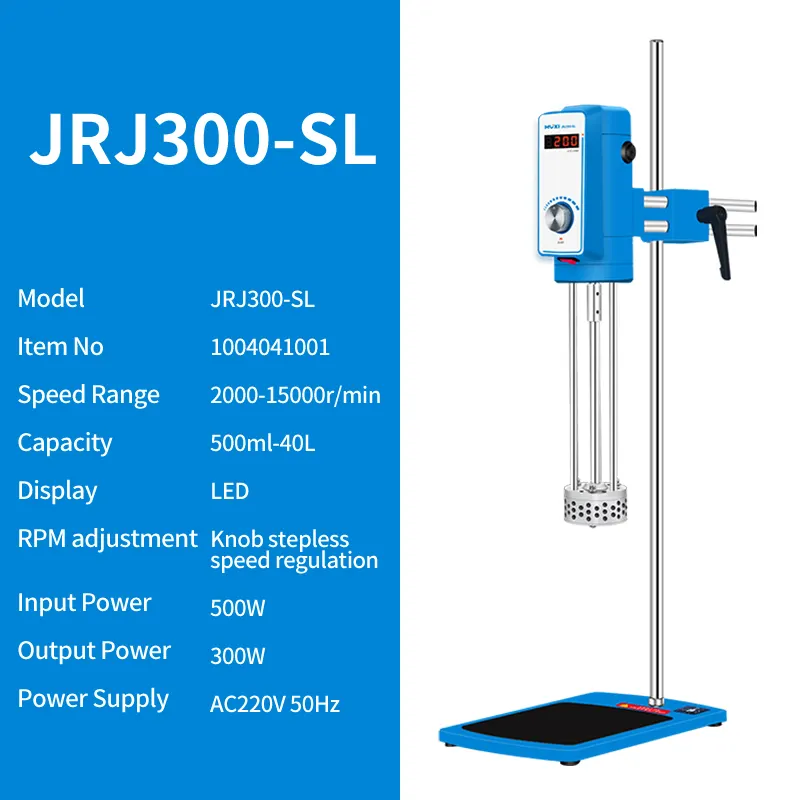
Choosing the correct equipment requires understanding how each technology delivers kinetic energy. Different samples respond best to specific mechanical forces. Applying the wrong force often leads to sample destruction or failed processing.
High-shear systems represent the most common tools found on lab benches. The mechanism relies on a high-speed rotor turning inside a stationary stator. The spinning rotor acts like a centrifugal pump. It draws the sample up into the processing head. Centrifugal force pushes the material outward. The material squeezes through narrow slots or holes in the stator. This action creates intense mechanical shear. The rapid expulsion slices the sample repeatedly.
These units excel at rapid emulsification. You will find them highly effective for blending immiscible liquids. They also disperse easily wetted powders into liquids exceptionally well. Formulators use them frequently for cosmetic creams, lotions, and basic food emulsions.
However, rotor-stator systems possess notable limitations. They prove highly ineffective for deep cell lysis. Tough organisms like yeast or spores resist mechanical shearing. Furthermore, creating genuine nano-emulsions requires prolonged processing times. Extended run times generate excessive friction. This friction heats the sample rapidly, potentially degrading sensitive ingredients.
Ultrasonic processors, often called sonicators, utilize high-frequency sound waves. A generator converts electrical power into high-frequency mechanical vibrations. These vibrations travel down a titanium probe immersed in the sample. The rapidly vibrating tip creates alternating high and low-pressure cycles in the liquid. This cycle generates acoustic cavitation. Millions of microscopic bubbles form, grow, and violently collapse. The implosions create tremendous localized forces. They literally tear apart surrounding particles and cell membranes.
This technology shines in life science applications. It remains the gold standard for DNA and RNA extraction. Researchers use it extensively for nanoparticle dispersion. It easily lyses bacteria and mammalian cells. The acoustic energy precisely shears cellular structures without adding chemical detergents.
The primary limitation involves extreme heat generation. The localized implosions create massive energy spikes. You must implement strict thermal management protocols. Ice baths and specialized cooling jackets are mandatory. Additionally, the mechanism strictly limits operation to liquid samples. The cavitation process cannot occur in dry powders or highly viscous pastes.
High-pressure systems operate on pure fluid mechanics. The machine uses a powerful positive displacement pump. This pump forces a liquid sample into a specifically engineered restriction valve. The fluid enters the valve at exceptionally high pressure. It accelerates tremendously as it squeezes through the microscopic gap. Upon exiting, the fluid experiences an immediate pressure drop. This rapid sequence subjects the sample to a combination of shear, violent impact, and cavitation.
Pharmaceutical developers rely heavily on HPH technology. It is the absolute best method for creating stable pharmaceutical emulsions. Researchers use it to formulate lipid nanoparticles (LNPs) for vaccine delivery. High-pressure processing guarantees ultra-tight particle size distributions. It ensures every droplet matches a specific nanometer profile.
These complex machines come with drawbacks. They require a significant upfront capital investment. Cleaning the internal micro-channels proves highly complex. Furthermore, the pump cannot process raw solids. You must prepare a well-mixed slurry before feeding it into the system.
Bead mills provide an entirely different approach. The mechanism agitates samples inside sealed tubes. These tubes contain grinding beads made from glass, ceramic, or stainless steel. The machine rapidly shakes the tubes in a multi-directional figure-eight motion. The high-speed movement forces the beads to collide with the sample matrix. These intense collisions physically crush and grind the material.
This method tackles the toughest biological samples. Researchers use bead mills for environmental samples like soil and roots. They easily pulverize bone, cartilage, and tough skin tissues. Bead mills also enable high-throughput processing. You can run dozens of small-volume tubes simultaneously in a single batch.
Let us review how these technologies compare across key metrics.
| Homogenizer Type | Primary Force | Best Application | Key Limitation |
|---|---|---|---|
| High-Shear (Rotor-Stator) | Mechanical Shear | Macro-emulsions, blending liquids | Poor at lysing tough cells |
| Ultrasonic (Probe) | Acoustic Cavitation | Nanoparticles, DNA extraction | Extreme heat generation |
| High-Pressure (HPH) | Pressure drop, Impact | Pharmaceutical LNPs, nano-emulsions | Complex cleaning protocols |
| Bead Mills | Physical Collision | Tough tissues, bone, soil | Strictly for small batch volumes |
Matching the machine to your sample ensures repeatable success. You must evaluate your specific constraints before finalizing a procurement decision. Focus on four primary operational dimensions.
Different sectors demand entirely different processing outcomes. Understanding industry standards helps clarify your own requirement profile.
Life Sciences & Biotechnology
Biomedical research focuses heavily on molecular preservation. Success depends on non-destructive cell lysis. You want high DNA and RNA yields. Over-processing shears long nucleic acid chains. Researchers prioritize ultrasonic systems and bead mills. These devices crack open cell walls while preserving the internal molecular structures. Maintaining low temperatures remains critical throughout the workflow.
Pharmaceuticals & Cosmetics
The medical and beauty sectors prioritize uniformity. In the cosmetics industry, an efficient Homogenizer ensures long-term shelf stability for creams. Pharmaceutical formulators focus on API (Active Pharmaceutical Ingredient) micronization. Decreasing API particle size drastically improves drug bioavailability in the human body. These industries demand precise adherence to GMP (Good Manufacturing Practice) standards. High-pressure systems often dominate this sector. They provide the most reliable, mathematically predictable droplet sizes required for FDA compliance.
Food & Beverage R&D
Food scientists tackle complex rheological challenges. They focus on flavor encapsulation and texture optimization. Processors frequently handle high-viscosity suspensions like gums, starches, and dairy proteins. High-shear rotor-stator systems excel here. They quickly hydrate thick powders and create stable mayonnaise or beverage emulsions without extensive pre-processing.
Developing a successful formulation on the lab bench represents only the first step. Commercializing that product requires scaling the process to pilot and manufacturing levels. This transition frequently destroys promising projects due to scaling misunderstandings.
The biggest danger lies in the pitfall of non-linear scaling. Processes rarely scale perfectly. A technique perfected in a 10mL beaker using an ultrasonic probe rarely scales directly to a 100L tank. Cavitation energy dissipates rapidly over distance. You cannot simply install a larger titanium probe in a giant vat. The fluid mechanics change completely. The edges of the large tank will not receive the necessary disruptive energy.
Selecting for scalability early saves massive downstream headaches. You should match your benchtop technology to potential production equipment. High-shear and high-pressure technologies offer highly predictable, mathematical scale-up models. Engineers scale rotor-stator systems by maintaining a constant rotor tip speed across different machine sizes. High-pressure systems scale by maintaining constant valve pressure. These mathematical correlations make transitioning from 1 liter to 1,000 liters highly reliable.
Eventually, labs must evaluate batch versus continuous flow processing. Small benchtop work usually relies on batch processing. You process one beaker at a time. However, large factories operate on continuous flow principles. If your end goal is commercial manufacturing, transitioning to an inline continuous lab homogenizer makes sense. Inline processing forces the material through a small mixing chamber in a single pass. This setup mimics eventual manufacturing conditions perfectly. It highlights potential flow rate issues before you commit to million-dollar pilot plant investments.
The best equipment choice depends entirely on your specific material and final goals. Raw horsepower and extreme RPM ratings mean nothing if the underlying mechanism suits the wrong application. A high-speed rotor-stator will never extract DNA efficiently. An ultrasonic probe will struggle to process a thick, heavy paste. Formulators must match the physical force to the physical problem.
We recommend a strict shortlisting logic. First, map your primary application. Decide if you strictly need cell lysis or fluid emulsification. Next, identify your strictest constraint. Pinpoint whether sample volume limits, thermal sensitivity, or stringent cleaning protocols dictate your workflow. Use this intersection to eliminate unsuitable technologies immediately.
Finally, never purchase based solely on a spec sheet. Always request an application-specific sample test. Reputable manufacturers offer lab demos. Send them your actual sample matrix. Let them prove the equipment can achieve your target particle size distribution before you finalize any capital equipment investment.
A: A blender uses a simple spinning blade to chop and mix large materials, creating basic macro-mixtures. A laboratory homogenizer applies intense precision forces like shear, cavitation, or extreme pressure. It reduces particle sizes down to the micron or nanometer level, creating permanent, stable emulsions that resist separation.
A: Generally, no. Most systems require a liquid medium to transfer kinetic energy. Technologies like high-shear rotors and ultrasonic probes rely on fluid dynamics and cavitation. To process dry samples, you typically need specific dry milling equipment like a specialized bead mill or a mortar grinder.
A: Heat generation is inevitable due to high friction and energy transfer. You prevent overheating by using pulsed operation modes, which allow heat to dissipate between active bursts. Additionally, always submerge sample vessels in ice baths or use specialized double-walled cooling jackets connected to a chilled recirculator.
A: No. Ultrasonic processors emit intense high-frequency acoustic waves that cause extreme ear fatigue and potential hearing damage over time. You must operate them inside a dedicated sound-abating enclosure. Operators should also wear proper personal protective equipment, including ear protection, when handling these devices.


