
+86-400-808-1508 zhaoxuemei1@huxishiye.com
English

Views: 0 Author: Site Editor Publish Time: 2025-08-29 Origin: Site


You may wonder if a homogenizer is better than a high shear mixer. The answer depends on your sample and goals. A homogenizer breaks down particles for even distribution. A high shear mixer blends materials at high speed for quick dispersion. Lab high shear homogenizer offers precise control for tough samples. You can choose the best equipment by considering your results and material needs.
Homogenizers create much finer particles and more stable emulsions than high shear mixers, making them ideal for precise and uniform products.
High shear mixers blend and disperse materials quickly with less energy and easier maintenance, suitable for larger volumes and thicker samples.
Choose equipment based on your sample type, desired particle size, and application needs to get the best results and efficiency.
Lab high shear homogenizers offer precise control and power for research, pharmaceuticals, and product development tasks.
Ultrasonic homogenizers work well for small volumes and very fine particles but are less suited for large or highly viscous samples.
You use a high shear mixer when you need to blend, disperse, or emulsify materials quickly and efficiently. This type of high shear mixing equipment uses a fast-spinning rotor inside a stationary stator. The rotor stator mixers create intense shear forces that break down particles and mix ingredients. You often see high shear mixers in the chemical, cosmetic, pharmaceutical, and food industries. They handle liquids, solids, and powders, making them versatile for many applications.
High shear mixers work well for tasks like dissolving powders, dispersing pigments, and forming medium-sized emulsions. You can use a batch high shear mixer for thick products or choose inline high shear homogenizer systems for continuous processing. These mixers handle viscosities up to 10,000 centipoise, and with special designs, they can process even thicker materials. High shear mixing equipment also includes SLIM technology, which helps you add hard-to-wet powders like gums and thickeners into liquids.
Tip: High shear mixers are energy-efficient and easy to maintain because they have fewer moving parts.
A high shear homogenizer takes mixing to the next level. You use this device when you need to achieve very fine particle sizes or stable emulsions. The lab high shear homogenizer uses a rotor stator design, but it operates at higher speeds and sometimes higher pressures than standard mixers. Some high shear homogenizer mixers, especially the high pressure homogenizer type, force your sample through a narrow orifice at high pressure. This process creates intense cavitation, impact, and shear forces that break particles down to submicron or even nanometer sizes.
You often choose a high shear homogenizer for applications in pharmaceuticals, dairy, and cosmetics. These industries require uniform, stable products. Inline high shear homogenizer systems allow you to process large volumes continuously, while lab high shear homogenizer models help you develop and test new formulations. High shear homogenizers excel at homogenization, making them ideal for micro and nano-emulsions.
You may wonder how a high shear mixer compares to a high shear homogenizer. The main differences come from their mechanical design, energy use, and the results they deliver. Homogenizers use high pressure to force material through a small opening, creating cavitation and intense shear. This method produces much finer particle sizes than high shear mixers. High shear mixers rely on the rotor stator principle, which generates strong but less intense shear forces.
Here is a table to help you compare the two:
Aspect | High Shear Mixer | Homogenizer |
|---|---|---|
Operating Principle | Uses high-speed rotor and fixed stator to generate shear forces for mixing and particle size reduction. | Uses high pressure to force material through a narrow orifice, creating cavitation, impact, and shear forces for finer particle size reduction. |
Particle Size Reduction | Typically achieves micron-sized particles (1-10 microns). | Can achieve submicron or nanometer particle sizes. |
Energy Consumption | Consumes less energy, suitable for low shear processes. | Consumes more energy due to high-pressure mechanism. |
Process Mode | Can be used in batch or continuous modes. | Usually used in continuous processes. |
Applications | Suitable for mixing liquids, dissolving powders, and medium emulsions (e.g., mayonnaise, cream). | Ideal for ultrafine dispersions in pharmaceuticals, dairy, and cosmetics requiring stable emulsions. |
When you use a high shear mixer, you benefit from lower energy consumption and easier maintenance. These mixers work well for mixing viscous ingredients and creating mid-size particles. Homogenizers, especially the high pressure homogenizer, use more energy but give you ultra-fine emulsions and stable dispersions. You should choose a high shear homogenizer when you need the finest particle sizes and the most stable products.
You will find both high shear mixers and homogenizers in many industries. They process a wide range of materials, such as paints, inks, ceramics, adhesives, gums, resins, and pigments. High shear mixing equipment helps you with emulsification, homogenization, particle size reduction, and dispersion. Rotor stator mixers handle products up to 10,000 cps viscosity, while high shear homogenizers excel at micro and nano-emulsions.
High shear mixers and dispersers are common in chemical, cosmetic, pharmaceutical, and food industries.
You can process liquids, solids, emulsions, dispersions, pigments, resins, gums, ceramics, adhesives, and powders.
Ultra-high shear mixers improve pre-mix quality before homogenization.
Powder injection systems help you add difficult-to-wet solids like fumed silica and titanium dioxide.
Note: You should select a lab high shear homogenizer if you need precise control and ultra-fine results for research or product development.
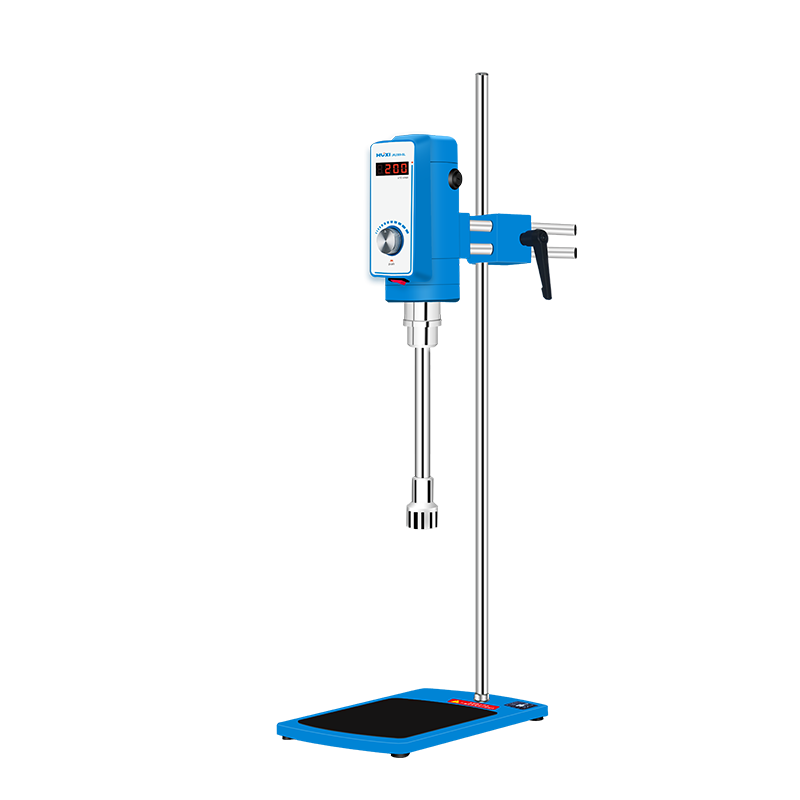
You will find that lab high shear homogenizer technology relies on the rotor stator mixers design. In this setup, a high-speed rotor spins inside a stationary stator. The rotor draws your sample into the narrow gap between the two components. As the rotor spins, it creates centrifugal force, pushing the material outward. The stator, with its fixed slots or holes, provides resistance. This interaction generates intense shear forces. These forces break down particles and droplets, reducing their size and distributing them evenly throughout the mixture.
Rotor stator mixers allow you to control the speed of the rotor and the size of the gap. By adjusting these settings, you can fine-tune the shear rate and the final droplet or particle size. This principle is essential for homogenization in industries that demand product consistency, such as pharmaceuticals and cosmetics. You can achieve stable emulsions, suspensions, and dispersions with this method. The result is a homogeneous mixture with a fine, consistent texture.
When you use lab high shear homogenizer equipment, you harness mechanical energy to process tough materials. The high-speed rotor creates a strong suction, drawing liquids and solids into the center of the rotor. The material then moves outward into the narrow gap between the rotor and stator. Here, the intense shearing action converts the rotor's kinetic energy into shear energy. This process breaks down substances into smaller droplets or particles.
You can achieve uniform dispersion and homogenization of your sample. The continuous mixing pattern, created by the ongoing radial expulsion and suction, ensures stable and consistent results. Rotor stator mixers excel at reducing particle size, which is crucial for applications that require fine emulsions or suspensions. In pharmaceuticals, you use this process to create stable drug formulations. In cosmetics, you rely on it for smooth creams and lotions. The food industry uses homogenizers to produce sauces, dressings, and dairy products with a uniform texture.
The high shear mixing process in lab high shear homogenizer systems involves several key steps:
The rotor blades rotate at high speed, creating a strong suction that draws your sample into the center of the rotor.
The material is forced outward by centrifugal action into the narrow gap between the rotor and stator, where intense milling and shearing occur.
The shearing action converts the rotor's kinetic energy into shear energy within the confined space.
A continuous mixing pattern develops as material is expelled radially and drawn back into the rotor, ensuring thorough and stable mixing.
You can process a wide range of samples, including viscous liquids, powders, and even cell suspensions. Lab high shear homogenizer equipment handles tough materials efficiently, making it ideal for research and development. You will see these homogenizers in pharmaceuticals, food, cosmetics, and biotechnology. In biotechnology, you often use them for cell disruption, which helps release valuable proteins or other cell contents.
Tip: If you need to create stable emulsions, disperse pigments, or break open cell walls, lab high shear homogenizer technology gives you the control and power you need.
Rotor stator mixers provide efficient homogenization, allowing you to achieve consistent results across different applications. You can rely on these homogenizers for sample processing, formulation development, and quality control. The combination of mechanical energy, precise control, and high shear mixing makes lab high shear homogenizer systems a top choice for demanding laboratory tasks.
You will find that homogenizers play a vital role in pharmaceutical applications. You use them for emulsification, particle size reduction, and homogenization. These processes help you create stable pharmaceutical formulations and improve product quality. The table below shows how you can apply a high shear homogenizer for emulsions and other specific applications in drug manufacturing:
Application | Description | Pharmaceutical Relevance and Benefits |
|---|---|---|
Emulsification | Mixing two immiscible liquids to form stable emulsions | Used to produce creams, ointments, gels; improves product stability and efficiency |
Particle Size Reduction | Reducing particle size to improve properties and performance | Enhances bioavailability of active pharmaceutical ingredients; uniform particle size improves product quality |
Homogenization | Creating consistent and uniform mixtures by reducing particle size | Essential for producing smooth creams and gels; ensures product consistency |
Deagglomeration | Breaking up agglomerated particles to improve formulation quality | Improves dispersion and efficacy of pharmaceutical formulations |
Wet Milling | Milling solids in liquids to create slurries | Used to break down active ingredients into smaller particles, enhancing bioavailability; improves processing efficiency |
You can achieve nanoemulsions with controlled droplet sizes using high-pressure homogenization. This method gives you stable products with long shelf life. You also benefit from repeatable results and scalable production, which are essential for pharmaceutical manufacturing.
In food and beverage applications, you rely on homogenizers for creating emulsions, uniform dispersion, and stable products. High shear mixing applications help you improve shelf life, texture, and flavor. You can process sauces, dressings, dairy, and beverages efficiently. Here are some benefits you gain:
Enhanced process efficiency and faster production times
Consistent particle size distribution for product quality and safety
Improved shelf life and reduced spoilage
Seamless incorporation of additives, emulsifiers, and nutrients
You can also use high shear mixing for paints and coatings in food packaging, ensuring safe and uniform layers.
You use homogenizers in cosmetics to create nanoemulsions and fine dispersions. These processes improve product stability and texture. In biotechnology, you apply homogenization for cell disruption and tissue dissociation. High shear homogenizers force samples through microchannels at high velocities, breaking cell walls and releasing valuable materials. You can adjust pressure and shear settings for different cell types, ensuring gentle tissue homogenization and tissue dissociation. Efficient cooling systems protect sensitive ingredients during processing. You also use high shear mixing for paints and coatings in cosmetic packaging.
In research, you depend on homogenizers for specific applications like cell disruption, tissue homogenization, and creating emulsions. You can adjust pressure and mechanical forces to disrupt various cell types, including bacteria and mammalian cells. This flexibility helps you recover proteins and other intracellular materials. Using pressure instead of heat preserves product quality. You can scale your process from laboratory to industrial production. High shear homogenizer for emulsions and uniform dispersion supports formulation development and stable emulsions in many fields.
Tip: You can use lab high shear homogenizer systems for rapid sample processing, formulation testing, and quality control in pharmaceutical, food, cosmetic, and biotechnology research.
You may want to achieve extremely fine particle sizes in your samples. Ultrasonic homogenizers help you reach this goal by using a vibrating probe. The probe creates cavitation bubbles in your liquid sample. When these bubbles collapse, they release powerful shock waves and shear forces. You can process small volumes, from just a few microliters up to 20 liters. Ultrasonic homogenizers work best with low to moderate viscosity samples, usually up to 4,000 cP. You often use ultrasonic homogenizers for dispersing nanoparticles, breaking cells, and making nanoemulsions in research labs.
Tip: Ultrasonic homogenizers give you rapid results for proof-of-concept experiments and prototype development.
You may wonder how ultrasonic homogenizers compare with high shear mixers. Both devices reduce particle size, but they use different mechanisms. Ultrasonic homogenizers rely on cavitation, while high shear mixers use mechanical shear from a rotor stator or impeller. You can see the differences in the table below:
Feature | Ultrasonic Homogenizer | High Shear Mixer |
|---|---|---|
Minimum Particle Size Achieved | Below 100 nm | Larger than ultrasonic homogenizers; generally less fine |
Mechanism | Cavitation-induced shear and shock waves | Shear forces from rotor-stator or impeller action |
Suitable Sample Viscosity | Low to moderate (up to ~4,000 cP) | Wide range, including higher viscosities |
Sample Size | Small volumes (10 μL – 20 L) | Versatile for various volumes |
Ultrasonic homogenizers produce much smaller particles than high shear mixers. You get better results for nanoemulsions and dispersions. High shear mixers handle a wider range of viscosities and larger sample sizes. You may choose a high shear mixer for thicker samples or larger batches.
You need to consider your sample type, desired particle size, and budget. Ultrasonic homogenizers cost less at the lab scale, starting around $450. You may face challenges when scaling up, and consistency can be an issue. High shear mixers cost more, with prices ranging from $450 to $8,000, but they last longer and offer reliable performance. If you work on short-term projects or need proof-of-concept results, ultrasonic homogenizers may suit your needs. For long-term use and larger volumes, high shear mixers provide better value.
Note: You should match your equipment to your application. Ultrasonic homogenizers excel at producing nano-sized particles in small batches. High shear mixers work well for larger volumes and higher viscosity samples.
When you choose between homogenizers and a high shear mixer, you need to match the equipment to your specific applications. Use this checklist to guide your decision:
Check the rotor-stator construction. A small gap between rotor and stator gives you maximum shear.
Look for variable speed settings. This feature lets you control shear forces for different applications.
Select mixers made from high-grade stainless steel. This prevents wear and corrosion.
Match the mixer’s capacity to your batch size and viscosity. This ensures efficiency and long life.
Choose equipment that is easy to clean and maintain. This reduces cross-contamination risk.
Consider power consumption. Energy-saving models may cost more upfront but save money over time.
Review your application requirements. Know your material’s type, viscosity, temperature, and shear sensitivity.
Balance your budget with long-term value and operating costs.
Pick suppliers with strong reputations and after-sales support.
Ask about customization options for unique processing needs.
Tip: Always match your equipment to your most demanding applications for the best results.
You can compare homogenizers and high shear mixers using the table below:
Aspect | High Shear Mixer | Homogenizers |
|---|---|---|
Volume & Viscosity Handling | Handles larger volumes and viscous samples | Less capacity for large volumes and viscous samples |
Cost | More affordable | More expensive |
Particle Size Distribution | Broader, less precise | Narrower, smaller particle sizes |
Processing Speed | Slower | Faster |
Uniformity | Less uniform | More uniform |
Typical Usage | Pre-processing before homogenization | Precision and speed after initial size reduction |
You might use a high shear mixer for large batches of sauces or creams in food applications. Homogenizers work best when you need very fine emulsions in pharmaceutical or cosmetic applications. If you process sensitive materials or need to avoid contamination, closed-system homogenizers offer better control. For research or pilot-scale applications, cutting-edge high shear homogenization solutions give you flexibility and precise results. Always consider your sample size, desired particle size, and the specific requirements of your applications before making a choice.
You can see clear differences between homogenizers, high shear mixers, and ultrasonic homogenizers. Each technology suits specific sample types and applications. The table below shows which equipment works best for different sample types:
Sample/Application Type | Suitable Homogenizer Types | Unsuitable Types |
|---|---|---|
Liquids | ultrasonic homogenizers, rotor stator homogenizers | High-pressure (for some tissues) |
Solids (alone) | Bead mill (for small samples) | rotor stator, ultrasonic homogenizers |
Solid/liquid suspensions | rotor stator homogenizers | ultrasonic homogenizers (for some applications) |
Emulsions | ultrasonic homogenizers (small volumes), rotor stator (larger volumes) | - |
High-viscosity samples | ultrasonic homogenizers (with adjustments) | rotor stator homogenizers (less suitable) |
Tissue homogenization | rotor stator, ultrasonic homogenizers (soft tissues) | High-pressure homogenizers (not suitable) |
Cell disruption | ultrasonic homogenizers, rotor stator homogenizers, bead mill | - |
You should match your equipment to your desired particle size. Homogenizers deliver submicron sizes, while high shear mixers create broader distributions. The chart below compares speed and torque for lab mixers:
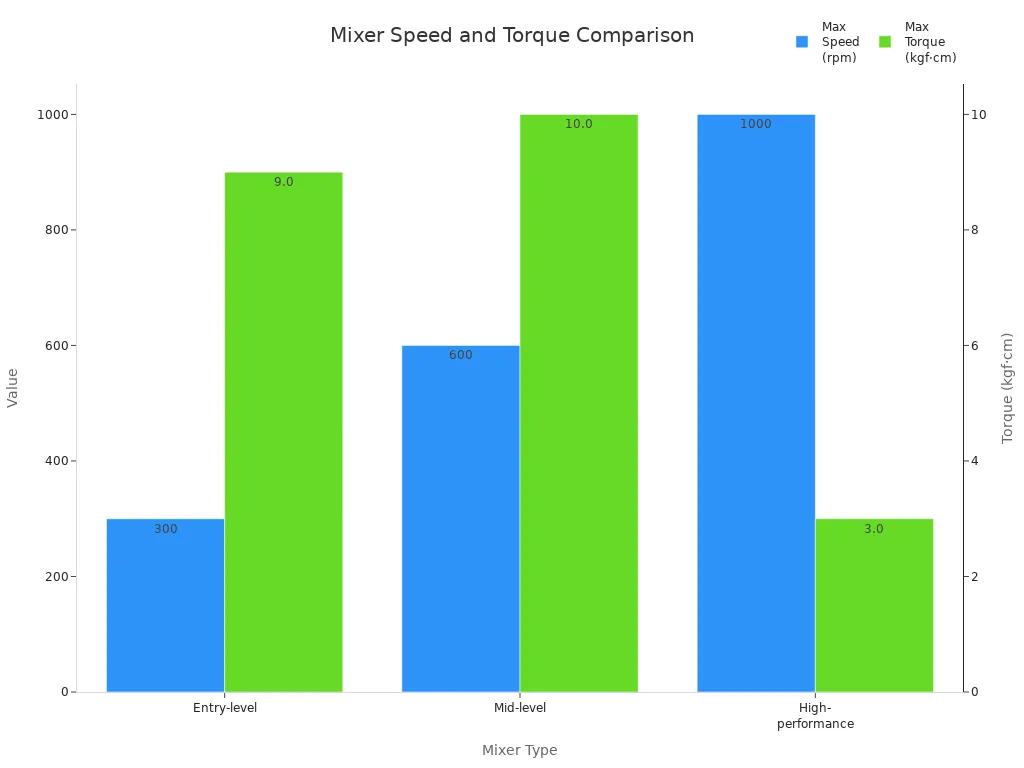
For best results, use the decision guide and consult experts. Your choice depends on sample type, particle size, and applications. Ultrasonic homogenizers excel in small-volume, liquid-based applications. You can achieve precise results by selecting the right technology for your applications.
You use a homogenizer to achieve very fine particle sizes and stable emulsions. A high shear mixer works best for fast blending and dispersing but does not reach the same level of particle size reduction.
You cannot use ultrasonic homogenizers for every task. They work well for small volumes and low-viscosity samples. High shear mixers handle larger batches and thicker materials better.
You should choose a lab high shear homogenizer when you need precise control, fine particle size, or stable emulsions. This equipment works well for research, pharmaceuticals, and product development.
You can use ultrasonic homogenizers for sensitive samples, but you must monitor temperature. The process can heat samples quickly. Cooling or short bursts help protect delicate materials.
You should flush the rotor stator homogenizer with water or a cleaning solution right after use. Disassemble parts if needed. This prevents residue buildup and keeps your equipment in good condition.


